Showing posts with label Big Cats. Show all posts

Wednesday, 28 July 2021

West Suffolk bobcat escaped while being transferred to a zoo, FIOA disclosure reveals

Big cat investigators spend a lot of time out in the wild with trail cameras and the like, but we can get a fairly good idea of what's happening by way of British big cat activity via Freedom of Information Act (FOIA) requests, to the police and to local councils, for example. This FOIA disclosure involves a escaped male bobcat shot and injured in Suffolk, after he was apparently rescued by the RSPCA who passed him on to a rescue centre where he was rehomed.

FOIA disclosures in response to my requests have uncovered the circumstances of the escape. They also hint at a former owner of multiple big cats somewhere in West Suffolk transferring a large number of "Dangerous Wild Animals" out of their ownership in the course of 2020.

Bobcat in Fort Worth Zoo by Wikimedia user "Malcolm", Wikimedia Commons Licence

Bobcats (Lynx rufus) are North American wildcats, similar in appearance to Canadian lynxes to which they are closely related (there are known lynx-bobcat hybrids). Bobcats are smaller than lynxes – bobcats can be up to 125cm (49.2 inches) long . They share the lynx’s characteristic of having distinctive tufts on the end of their ears and short tails – the name “bobcat” comes from its short tail, the short tails of rabbits being "bob-tails" in American English.

A Dangerous Wild Animals (DWA) Licence is needed to keep bobcats in the UK – they need an enclosure built to a standard specified in the Act, subject to inspection, which needs to be monitored with CCTV cameras. The owner also needs public liability insurance against damage caused by the animal. Animals have to be microchipped as well.

DWA licences are issued by local authorities, who are also responsible for enforcement of the Dangerous Wild Animals Act is down to local councils. In the case of West Suffolk it’s done through their licensing department. West Suffolk is a recent merger of the two Districts of West Suffolk, which are in turn devolved administrations – Forest Heath and St Edmundsbury – that fall within the boundaries of the county of Suffolk.

Those who keep big cats (in the UK it seems to be overwhelmingly men) are aware that in the UK’s current austerity regime, the ability of cash-strapped local authorities to actually carry out any enforcement. As we will see, West Suffolk took action to seize that bobcat once they’d identified its owner – probably through its microchip which would be linked to his owner’s DWA licence – but once it became clear that the owner was selling or giving away all their big cats (see below), West Suffolk probably decided to let it go, they probably didn’t feel like going through the expense of prosecuting the owner for negligence or for failing to report an escape.

As someone who investigates big cats in Suffolk, I was alerted by one of my many sources to the fact that an injured bobcat had turned up at a vet’s "near Bury" (Bury St Edmunds, West Suffolk). The bobcat had been shot in March 2020 (during full-on Lockdown 1.0) by a farmer who’d lost a lot of chickens to something. They had apparently sought the advice of police, who advised him that the was within his rights to shoot at it to scare it away. I was shown photos of the injured bobcat in his huge pet carrier at the vet’s, also an X-ray showing pellets lodged in his front legs and one of his eyes. (I was shown the photos on the understanding that they were not for publication.)

I was also told that the vet’s assistant had by chance done their internship on a conservation project with Iberian lynxes in Spain, so treating a closely-related bobcat for its injuries was relatively straightforward for the team there. I cannot reveal the identity of the vet, other than to say there are so many vets "near Bury", Suffolk being a very agricultural county, that I can safely use the phrase "vet near Bury" without risk of identifying it.

The story broke shortly after, in an exclusive story in The Sun. This red-top daily is actually getting surprisingly good at covering big cat stories. Under the headline "Big Cat Rampage: Bobcat goes berserk and savages farmer's chickens after escaping owner before being shot and captured", The Sun of 24 March 2020, the story is online here. It revealed that West Suffolk Council had started in an investigation into the circumstances of the bobcat’s escape. On the basis of this information, I made a FOIA request to West Suffolk.

West Suffolk’s unnamed FOIA Coordinator was kind enough to pass on to me a series of emails, with the names and email addresses redacted in accordance with data protection regulations. Fortunately for me, they’d been a big slack at redacting the job title on some of these emails, a quick look at the RSPCA’s website confirmed that Animal Collection Officer is a job title from within the RSPCA. The injured bobcat had apparently come into the care of the RSPCA who took it to the vet and passed him on to an (unnamed) refuge centre where he was rehomed.

Here is West Suffolk’s correspondence with the RSPCA about the bobcat:

Correspondence between West Suffolk's licensing division and the RSPCA about rehoming a rescued, injured bobcat.
West Suffolk advises the bobcat's owner that they have seized it under the Dangerous Wild Animals Act

If I have understood the correspondence and the Sun story correctly, while waiting to find out if the bobcat would be claimed, either the RSPCA or the vet seems to have called up their contact who they would ring whenever there was a lynx or bobcat that needed fostering.

That’s right, if my information is correct, the RSPCA in West Suffolk has a number for a lynx fosterer that they regularly ring – suggesting that it’s a common enough occurrence that they have a lynx fosterer on standby. Ownership of lynxes and bobcats in West Suffolk – whether licensed or not – may be much more common than anybody thought.

West Suffolk’s Service Manager (Environmental Health) wrote to the bobcat’s owner. They advised the owner that the Council that as of 20 March 2020, they "have today seized... an injured bobcat belonging to you and kept under licence by you." The bobcat’s owner soon replied with an apology regarding this "unfortunate escape". (The disclosure confirmed it was the only DWA escape West Suffolk had on record.)

The bobcat's owner apologises for not having reported the escape earlier and admits that the animal had escaped while being transferred into a vehicle to be rehomed to a zoo.

The owner replied with a rather peremptory apology and the briefest of admissions that they had made an “error of judgement” in not reporting the escape of a bobcat. (As well as an error of judgement, it’s also a breach of the law, owners have a duty to report escapes and local authorities have a duty to record these. West Suffolk confirmed to me the bobcat on the loose was the only recorded DWA escape in their jurisdiction to date.

The owner explained, in a scene reminiscent of the opening of the original 1993 Jurassic Park film, that “the bobcat was being homed to a zoo when the escape happened, on loading the cat, he lurched forward with force and the carrier fell, hit the floor releasing the door, in which he then escaped.” The owner went on the say that "we have been rehoming all DWAL animals and will not be renewing our licence this year."

West Suffolk requests from bobcat's owner details of how many Dangerous Wild Animals Act notifiable animals they still have.
West Suffolk requests from the bobcat's owner an update on the wildcats that were in their possession.

There’s also correspondence between West Suffolk and another entity – possibly the bobcat’s owner – asking for data on their DWAs. From this it seems that whoever it was whose bobcat escaped near Bury was winding down their big cat keeping operation. They confirmed to West Suffolk that in the year up to May 2020 they’d offloaded two caracals, two bobcats, (plus the one that West Suffolk seized and the RSPCA rehomed), one serval and two jungle cats to at least one third party.)

Bobcat's owner provides information on the fate of their wildcats (including the injured bobcat), destinations of these are redacted.
West Suffolk asks the bobcat's owner if the jungle cats have gone to... (redacted).

By June 2020 the owner had confirmed that "all bobcats have been rehomed" (the Council had a list of four bobcats licenced to that individual.) The final email in the FOIA disclosure has the owner anticipating a visit from "licensing" to check that there were no longer being kept on the premises any DWAL animals for which a licence would be needed.

Former owner confirms all bobcats have been rehomed, and confirms that jungle cats have indeed gone to... (redacted).
Former owner confirms they will not be renewing their Dangerous Wild Animals Act licence

I am reminded of other evidence of there being more lynxes and bobcats than anyone realised in West Suffolk. I have heard accounts of strange screams coming from Thetford Forest, as well lynx sightings in West Suffolk, including one in Red Lodge. Around 2005, people regularly heard such screams around Santon Downham, and there was said to be a "lynx man" locally who "everybody knew" kept lynxes. There are legitimate lynx re-introduction programmes in progress in Europe at the moment – parts of Germany and the Czech Republic are re-introducing lynxes. While a plan for the re-introduction of lynxes into an enclosed area of Thetford Forest (Norfolk-Suffolk border) was rejected, a proposed lynx re-introduction in Aberdeenshire is going ahead. The "lynx man", if he existed, could have been breeding lynxes as part of such a programme, he would obviously want to keep such activities very low-key.

The Press Association’s investigation from 2016 showed that at the time there were Dangerous Wild Animals Act licences for seven lynxes and two bobcats in West Suffolk. These two bobcats would now seem to have been accounted for, one male rehomed by the RSPCA, the female rehomed to (redacted).

An RSPCA official has confirmed to me that "this is one of our jobs and the photos are ours" (the photos of the injured bobcats at the vet’s, as seen in the Sun story. I am in negotiations with the RSPCA about the possibility of getting permission to reproduce the photos.

My source in East Anglian animal rescue told me there are a lot of owners of exotic animals (monkeys, exotic reptiles and big cats in particular) who keep them under the radar and don't bother getting a licence for their animals, so unrecorded big cat ownership and escapes in the country may be more common than official data suggests.

Sunday, 21 June 2020

Appearance on Weird Tales podcast, talking about big cats in Suffolk, woodwoses and mummified cats

I recently appeared on the Weird Tales Radio Show podcast, hosted by my colleague Charles Christian, who I persuaded to rejoin the NUJ after a quarter of a century. (He refers to his NUJ membership in the intro.)

You can listen here. It's a couple of minutes short of a hour. I hope to later add links to my articles on the subjects covered, in the order in which they are discussed in the podcast.

Tuesday, 12 March 2019

A big cat sighting from Mellis

Mellis, on the edge of Suffolk not far from Diss, is famous for having the biggest unfenced common in England, with rare orchids growing on it. It's not to be confused with another Suffolk village, Mells, which is on the edge of Halesworth by the Halesworth golf course. Somebody in Suffolk Highways Department did apparently confuse Mellis with Mells once. There was said to be a sign pointing to "Mellis" which was in fact pointing to nearby Mells, with the "I" crossed out in marker pen by a helpful local resident (allegedly).

I recently met a man who had relatives in Mellis, who told me of a big cat sighting he had there back in 2012. I hear more and more historical reports of big cats seen in Suffolk from that year, it seems as if there was a 2012 big cat wave in the county that no one noticed at the time.
My witness had just got up and was in his garden, looking over nearby fields - he thinks it was probably wheat, still growing as it was early summer. It must have been around 7am.

Suddenly, he saw in the field a black big cat. He described it as like a "muscular" domestic cat, with the same proportions and the same pointed ears, only HUGE. It was so huge that it was carrying a hare in its mouth - not a rabbit, a hare. I've seen a hare up close to my own domestic cats when they were out walking near my house, and the hare (an adult male, I think) was bigger than my small tortoiseshell female cat. Dog owners who have dogs who chase rabbits and hares (despite their efforts to stop them) tell me that in order to accommodate a hare in its mouth, a big cat would have to be "spaniel-sized" at the very least.

Our massive big black domestic cat had long teeth and "eyes like the Devil", with which he looked at our witness. He was glad he only got a look at him for "seconds", he told me, so disturbed was he by what he saw. After giving him a casual glance, the big cat sauntered off and disappeared among the crops.

Some big cat investigators believe that Britain's big cats aren't escaped black leopards or pumas or lynxes and their descendants after all, but really huge feral cats who've somehow gone gigantic. Recent camera trap footage of Scottish wildcats picked up a wildcat that was almost four feet long, so it is possible.

According to the Big Cats in Britain Yearbook 2007, at around 8.30 am on 11 August of that year, a witness driving through Mellis Suffolk, driving along Main Street to join the A143 at Wortham, saw a "large black cat, long and wiry," in field, for 30 seconds before it "crouched down and slunk off into the undergrowth.

Wednesday, 12 April 2017

Back cover image for Mystery Animals


Here's a draft back cover image for Mystery Animals of the British Isles: Suffolk. It's waiting for some text, the CFZ logo and the ISBN bar code. All provisional, of course. There will be an explanation of the photos inside the back of the book. Copyright: Matt Salusbury 2017.


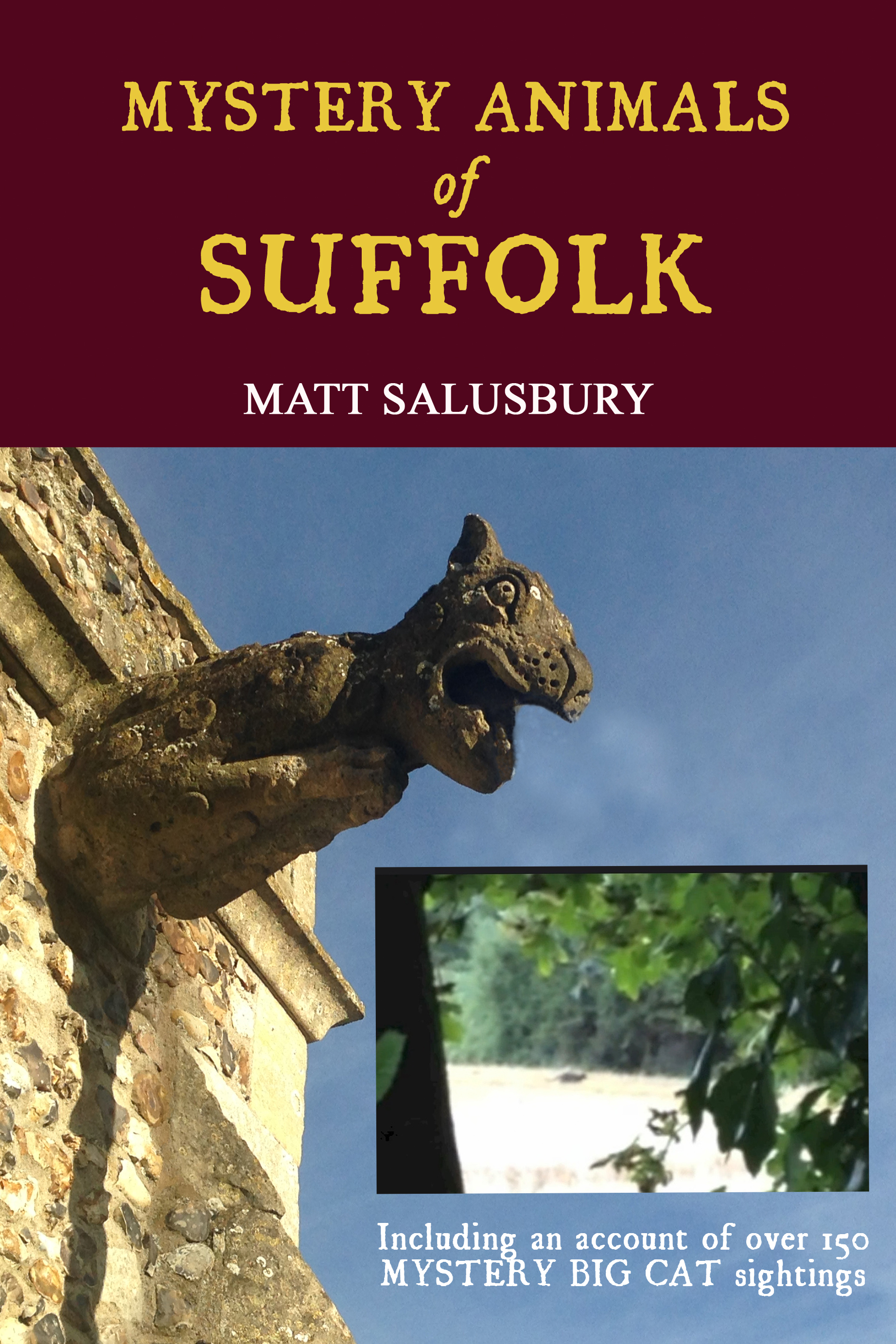
Update: My book has now been published as Mystery Animals of Suffolk, available from bigcatsofsuffolk.com or via its distributor Bittern Books.


Sunday, 18 December 2016

Mystery Animals of the British Isles: Suffolk - an update


The Hay Wain with Melanistic Leopard - with apologies to John Constable. Many of Suffolk's big cat reports come from the area of South Suffolk known as Constable Country along the Suffolk bank of the River Stour, on the border with Essex. Constable's original Hay Wain depicts Flatford Mill on the Suffolk bank of the Stour, seen from the Essex bank, not far from his birthplace at East Bergholt. Illustration from the forthcoming Mystery Animals of the British Isles: Suffolk


There's already a front cover. It shows a 15th-century panther gargoyle from St Peter's Church, Theberton


Oops! Better make that 2017! Sorry! "Author biography" from the current Fortean Times issue FT348, which includes my article on the Cutty Wren from Middleton, Suffolk

I've been asked for a progress report on my forthcoming and long-awaited book Mystery Animals of the British Isles: Suffolk.

Why has it taken so bloody long? Recent - now resolved - health issues aside, the flow of regular, paid-at-the-end of the-month work I can't turn down has rather got in the way. Also, when I started on the book at the end of 2014, I foolishly imagined big cats weren't really a big thing, and that a short section of big cats in the book might turn out to be a bit disappointing. Well over 170 reported or recorded Suffolk big cat sightings later, going back to 1974, this has turned out not to be the case!


My map of Suffolk showing nearly all the locations in the book, I'm about to add the big cat sightings!

I've been laying out the book myself, and I have the following still to do: one more illustration, some maps (a completed one is below, it needs some tweaks as it was bit faint on a test-print), bibliography, adding page numbers to the index and contents pages, finding some space to squeeze in some last-minute big cat reports if possible, moving around some pages in the layout, back cover illustration and then all done. At that point, hopefully soon, I will have some proofs to go to the proofreaders, and to Fortean Times co-editor Paul Sieveking, who is writing a short foreword. (He was born and bred in Snape, it turns out.)

There will be a book launch when the book's out, in Ipswich. To get on the "guesty" (guest list), email mysteryanimalsof suffolk@gn.apc.org. There are other Suffolk events around Mystery Animals planned, Moyse's Hall Museum, Bury (Bury St Edmunds) and Dunwich Reading Room are already interested.

Meanwhile, announcements are on the Twitter account at @MysteryAnimals


A tongue-in-cheek take on the fate of the Beccles Lynx, shot in Great Witchingham in 1991, found in a freezer in Beccles by Defra and Norfolk Police, and rumoured to be on display in a stately home somewhere in the Beccles area (there are lots of them!).


Update (2024): my book has now been published as Mystery Animals of Suffolk, available from bigcatsofsuffolk.com or via its distributor Bittern Books.


Friday, 1 January 2016

North Suffolk mystery mutant moggy misidentification

Early one morning at the beginning of September 2015, I got a call from a free range poultry farmer in a secret location in North Suffolk who told me their CCTV security camera had captured what looked like a big cat.


The North Suffolk mystery mutant moggy - but read to the end!

We convinced ourselves we had seen some sort of young puma, or possibly some long-legged, pointy-eared lynx or serval. (Whatever it was appeared to have a long, slim body with a relatively short tail. At first we thought it had a dark patch at the end of its tail, like a puma's, but on closer inspection this seemed more likely to be some kind of shadow.) The footage began with a cat-like animal, shot in infra-red on a dark night at around 1am, walking towards the farm gate. Its eyes were two huge blobs that reflected the infra-red light. Then it walked towards a building just out of shot, at which point it tripped the visible light motion-sensor light and more details became visible. Possibly reacting to the light coming on, the mystery cat did a turn and casually walked out of view at the bottom of the shot. (It's a CCTV camera bolted to a wall, it doesn't move.) The whole sequence lasted just under a minute.


Its eyes shining in infra-red, the North Suffolk mystery mutant moggy approaches


It was an odd-looking cat - long limbed and long-bodied with a small head. My first reaction on seeing it was that I wasn't immediately convinced it was a big cat, but I felt that it couldn't be an ordinary domestic cat because its proportions were completely "wrong."

The CCTV records the footage on a desktop PC, it's not very high resolution and it was filmed mostly in infra-red in darkness. It was hard to make sense of the footage. Sometimes the mystery cat appeared like a stripped-down, wiry whippet-like slim puma, a bit like the pumas you see in South America. In a couple of frames, just after the light hit it, it appeared mottled or spotted. In one frame we thought we saw long pointed lynx-like ears. I realised most of this "data" was in fact artefacts produced by a low-resolution camera in low light.


Are the spots or is its coat mottled? Or is it just an artefact of a low-resolution camera struggling to capture data in low light in infra-red?


And are those pointed ears? Or is it another digital footage artefact?

The biggest problem with the footage is that it's filmed in just a featureless tarmac yard - there's absolutely nothing to give any kind of scale, except for a black rubber doormat in front of the door of a just-out-of-shot building. (We measured the length of the doormat - just over 1.83 metres.) When the light comes on, you can see in the footage the shadows of the bars of the gate, and various people suggested some complicated maths involving the length of these shadows and the length of the shadow thrown by the cat, and the distance of the light source from the camera. For various reasons we had to discount this.


As the creature walks out of the shot, the shadows of the bars of the farm gate are visible


My witness said his CCTV had some months earlier shown a "big domestic cat" (a feral?) that looked "nothing like" whatever showed up on his CCTV that early September night. Unfortunately, the software automatically overwrites footage that's not saved, and he didn't realise at the the significance of the earlier footage might have in offering some kind of comparison for scale.

Within a few days I was on the scene with the farmer, and we started doing some measuring, based on our estimate of how near the mystery cat got to the mat. It appears to walk alongside the mat for a second. From the farm office where the monitor for the CCTV cameras is, we were able to set up some crude markers based on shouted instructions out of the window in the approximate (emphasis on approximate!) distance from the edge of the mat that the cat got to in its walk.

There was some maths and some measuring the screen of the monitor and the proportions of the shot, and working out where to place markers based on this. We were warned by an expert at this point that just going out and measuring in real life features that animals walk past in the footage often isn't a reliable enough guide - there are all sorts of factors like perspective to take into consideration as well. This is especially true if the animal walks towards you in the shot.

We realised this was not very scientific and further study would be needed. Our very tentative estimate was that we were dealing with an animal that was just under a metre long, minus the tail. This would make it the size of a not very big puma. The way it hung its tail - pointing downwards then upwards at the end - seemed uniquely "big cat"-like at first, but in the following months I noticed some domestic cats - marmalade cats in particular - held their tails like this too.

We decided not to release to the media any footage until we'd got some more expert opinions and definitive measurements. Jon Downes, director of the Centre for Fortean Zoology, advised caution, and recalled some red faces when some previous footage of a "big cat" turned out to be just an ordinary domestic cat. A room full of close to a dozen big cat experts at a gathering of British Big Cat Research Group people came to the conclusion that our footage was more likely to be a "mutant moggy" than our hypothetical "North Suffolk young puma." The prospect of a mutant moggy feral domestic cat close to a metre long, though, was an exciting one!

British Big Cat Research referred us to Mark Fletcher, a wildlife filmmaker who works both in the UK and the US (his work includes filming North American pumas in the wild). He was happy to do some "scaling" work for us, overlaying video images from the footage on something that could give an idea of scale (he's done this sort of work before). First we needed, though, to get some measurements - to go back to the location in the CCTV with some measuring poles and ideally some big cat cut-outs with stands that could be positioned at various points in the yard for comparison.

After various delays (other - paid - work for me, mostly) I finally turned up at the secret North Suffolk location with my improvised archaeologist's-style measuring pole - one metre long, with a 50cm stripe in red and a 50cm stripe in white. (I'd talked to real archaeologists at the Dunwich Dig in August, they told me it should be two metres long, but I had to transport it by bike part of the way. (My previous cryptozoology trip to a nature reserve in Kerala, India, was much easier than getting a mere 30 miles across Suffolk by folding bike and public transport!) I'd sent the cardboard cut-outs ahead by post.


Me with the original one-metre long mystery mutant moggy cut out. It was way too big and the legs were far too long, as it turned out.

The cut-outs I'd made were a one-metre long, long-legged slim big cat (based on trying to make sense of the footage), which I gave a triangular chin and a short tail. Our first trial run with the cut-out in front of the CCTV camera showed that I'd over-estimated the legs - so we did the "big cat cut-out run" again, with the legs of the cut-out tucked in and taped back so they weren't so ridiculously long.


The "shortened-legs" version of the big cat cut-out, with a one-metre measuring rod for comparison

Our second cut-out was inspired by one that appears in a photo in Big Cats: Facing Britain's Wild Predator (page 51). This is a 75cm-long cat with a more domestic cat-type body, 75cm being the point at which big cats become "of interest." I named this cut-out the "biggest possible domestic cat" cut-out. (Photo to follow.)

Our third and final cut-out was a domestic cat cut-out, intended as some kind of control. Curiously, both the domestic cats at my home declined to be measured for this - I eventually got the "average" domestic cat measurement of 50cm long excluding tail from a reference book. My own domestic cat completely freaked out when they saw the "big cat" cut-out too. My partner's cat was as unfazed as he is by everything else, and walked up to the domestic cat cut-out to demonstrate that is was about the right size.


Domestic cat cut-out compared to one-metre measuring pole

The whole thing was nearly called off because our measuring day coincided with a gale, but I managed to persuade our man in North Suffolk agriculture to let me go an in, measure, out quick-as-possible expedition. It's a part of North Suffolk where everybody knows everybody, so I had to do the "cut-out runs" in front of the camera literally at a run. There were occasional cars going past his farm, and I didn't want to compromise his anonymity with any suspicious goings-on with big cat cut-outs.


Simulating a big cat walking around the same yard as in the above nocturnal footage. Just visible on the right is the same doormat (covered in leaves) that's the only discernible feature in the night-time footage

So finally we had some footage of me marching around a yard with a one-metre measuring pole, following as best I could the path taken by our mystery mutant moggy. This was followed by "runs" with our one-metre-long big cat cut-out (with and without modified legs tucked in), our 75cm-long "biggest possible domestic cat" cut-out and, finally, our domestic cat cut-out for comparison.

I'd abandoned placing the cut-outs standing up in various parts of the yard because the gale meant they'd blow over, so I just walked them across the yard, not always able to ensure they touched the ground, as the wind was so strong. We also had to be quick as the rain would quickly turn the cardboard they were made from into papier-mache. Footage of me doing all this recorded on CCTV, my partner in crime said he'd been inspired to return at a later date after dark (as in the original night-time footage) and repeat the exercise.


Performing for the benefit of the CCTV camera again, this time doing the walk with a "legs shortened" big cat cut-out

I sent off our little films of me briskly walking around the yard with cut-outs to Mark Fletcher, who very quickly got back to me with "overlays" that revealed that our mystery mutant moggy was, beyond doubt...

an ordinary domestic cat! And a small one at that!


Oops! The ghostly overlaid cat (bottom right, superimposed on measuring stick) is awfully small!


The above still from the video shows me with a measuring pole, placed on the ground as I reconstruct the walk of the mystery mutant moggy in the original footage. Superimposed on it is the ghostly outline of the big cat from the original footage, in exactly the same spot. (It's a fixed CCTV camera, the camera doesn't move.) The ghostly white rays are the illuminated gaps between shadows in the night-time footage, which show up on the overlay.

The "North Suffolk mystery mutant moggy" affair shows how easy it is to misidentify animals as big cats, particularly in the dark. I feel it's been a useful exercise, and the outcome shows the value of getting your mystery animal footage and photos checked out before you release them to the media. (I'd run it past Dorothy Byrne, head of Channel Four News, who'd past it on to ITN, and I'd contacted BBC Radio Suffolk who'd past me on to the BBC East Anglia bureau, but we'd all agreed to hold our horses for the time being, as it were.)

We had applied scientific methods and, as the police would say, eliminated from our enquiries one mystery "big cat." The best evidence for a big cat in Suffolk remains an ambiguous and faint 1990s photo of a big paw print from Dunwich Forest. (Elsewhere in the UK, the evidence for big cats is much better.)


The North Suffolk mystery mutant moggy didn't even come close in size to the "biggest possible domestic cat" cut-out

I'm also now much better equipped to respond to any other footage or photos from a particular location that come my way from Suffolk - or from East Anglia. I'm getting reports of big cat sightings, both recent and in the last few years, from North Norfolk as well.

My North Norfolk informant says there's a rumour going round that someone shot and killed an black leopard in North Norfolk in 2013 and in traditional East Anglian fashion, kept quiet about it. I couldn't help noticing that my database of well over 100 big cat sightings in Suffolk and just over the Norfolk border has a significant dip around 2013, the only year in which Suffolk Police recorded no big cat sightings at all.) My cut-outs will have pride of place at the book launch for Mystery Animals of the British Isles: Suffolk, which will be somewhere in Ipswich early this year. (mysteryanimalsofsuffolk@gn.apc.org for enquiries about the "guesty" for this.

I also have convincing testimony from a witness who's seen a different type of big cat - a black leopard - through a telescopic rifle sight in the immediate vicinity, and heard several other reports of a sandy big cat in the immediate neighbourhood. So there is, it seems, something big out there. As a result of this exercise, I'm in talks with some people about the possibility of setting up some camera traps on my North Suffolk informant's land, in what could be a possible "big cat corridor."

Thanks to Mark Fletcher, Rick Minter, Jon Downes and others who will have to remain nameless for their help and advice on the "North Suffolk mystery mutant moggy" and to the drivers and bookings team of the excellent Suffolk Links Pathfinder Demand Responsive Transport service for getting me most of the way there and back.

And finally... what about the weird proportions of our skinny, long-bodied, long-legged mystery mutant moggy, whose shape first led me to believe it couldn't be just an ordinary domestic cat? I showed the footage to someone in East Anglian animal rescue, who told me he though it could be a savannah cat - a cross between a serval and an Abyssinian cat.

They're "legal" from F3 - the third generation of being crossed with "domestics", but anything that's got more serval in it and you need a licence to keep it, and only a very small number of people in the UK are licensed to breed F1 and F2 servals. My East Anglian animal rescue source tells me he's heard from one of these legal breeders that there are unlicensed breeders out there in the East of England too, who are still breeding - and releasing - hybrid domestic cats with an awful lot of serval in them. So our small North Suffolk mystery mutant moggy could in fact be a mystery mutant hybrid exotic.


Update (2023): My book has now been published as Mystery Animals of Suffolk - including an account of over 150 mystery big cat sightings, available from bigcatsofsuffolk.com or via its distributor Bittern Books.


Monday, 25 May 2015

West Suffolk big cat field expedition

I went to see some big cat sighting locations in West Suffolk (Newmarket, Red Lodge, Mildenhall Woods, West Stow and Culford) for myself on Saturday, and looked for possible big cat field signs. The people of West Suffolk are much more sceptical about big cats than those in East Suffolk, it seems, although the explanations they offered for big cat sightings were beginning to sound a bit like "ignited marsh gas and the planet Venus" from Men in Black. You'll have to buy a copy of Mystery Animals of the British Isles: Suffolk when it comes for more detail!


Scattered feathers in the King's Forest, "inconclusive", as Natural England would say.


Old West Suffolk County Council initials on Red Lodge bridge, right on the Cambridgeshire border. (Suffolk was once two counties, West Suffolk, with its country town at Bury, and East Suffolk.)


Evil freshwater mermaid on a tattooist's sign at Mildenhall, just up the River Lark from where freshwater mermaids were said to live at the Mermaid Pits at Fornham All Saints. They were clearly tales made up to stop children playing in rivers and ponds.


"Welcome to Suffolk" sign at Newmarket, where Suffolk is at one point a corridor a couple of hundred yards wide, with Cambridgeshire on both sides. The sun has leached out the sunburst symbol over the water at the bottom of the logo.


Looking for field signs of big cats in woodland in Red Lodge. There are a couple of bags of possible big cat poo in my freezer - they had a lot of hair in them, but possibly not enough (deer) hair for it to be a big cat's. Analysis follows.


I wish I had more time to linger in Mildenhall Woods, where a couple saw a big cat in September 2014. If I were a big cat, it's the sort of place I'd hang out.


The ghost of one of horseracing history's most famous jockeys, Fred Archer, riding on his favourite horse, Scotch Pearl, has been seen galloping on the exercise tracks in Hamilton Lane, Newmarket, not far from this equestrian bin in the High Street. Archer, unusually tall for a jockey, shot himself after the death of his wife and probably as a result of his depressing weight loss diet.


Some of the 3,000 thoroughbred racehorses exercised every day at Newmarket, some are worth £1 million. They seem to panic easily - a paper bag caught in the wind will set them off, according to a local Town Councillor and Justice of the Peace, the first farrier to serve as a magistrate since the Farrier's Company records went up in smoke in the Great Fire of London. He also said some jockeys are 7kg below their healthy bodyweight, so it's "No wonder some of them go off the rails."


The River Lark is a trickle at the bottom of a ditch where it passes within 300 metres of the West Stow Anglo Saxon Village museum. It was down by the river where a visitor reported seeing a "puma" two years ago. The staff member I talked to thought it was a misidentified muntjac.


Russet Drive, Red Lodge, scene of a 2009 big cat encounter.


Rather big cat-friendly "derelict land" at the back of Russet Drive, Red Lodge, where Jackie Ellerton saw a "huge and spotty... feline creature” twice the size of an ordinary cat early one morning in 2009.


Fields immediately outside Newmarket as you leave on the Newmarket-Dullingham train. Someone saw a black big cat running alongside the train as if left Newmarket in January this year. "Are you yanking my chain?" asked the sceptical train conductor when I mentioned this. He suggested a misidentified black racehorse, "there are plenty of them."


A panoramic view of Suffolk at its narrowest point, on the Eastern edge of Newmarket along the Bury Road (A11), showing Cambridgeshire to the north (on the left) and to the south (on the right).

Tuesday, 28 April 2015

North Suffolk big cat expedition


Woodwose on the porch at Yaxley church

I've just returned from a brief expedition to North Suffolk, staying with one multiple big cat witness near Eye and getting a lift back to Dunwich from another one. I was shown round the location of a sighting of an "Alsatian-sized" black big cat of "muscular build" with a "long, thin tail" (on condition of no photographs) and had a quick look at Lowgate Street, Eye, the location of a "big black cat" sighting in 2008.

I was also able to photograph three "woodwoses churches". The first was Yaxley, where there's a magnificent woodwose on the porch with particularly fine detail on the body hair. He's being attacked by two small lions, one broken. (Photo above.)

The second was Mendlesham, where two large and terrifying woodwoses with clubs are on the roof of the porch (it makes them hard to photograph). By the sound of it. Mendelsham had a service on when we arrived, it being a Sunday, as did Wickham Skeith.


One of the fierce woodwoses on the roof of the porch at Mendlesham

The Wickham Skeith woodwoses - heavily damaged - are on the font, so I knew I'd have to interrupt the service to photograph them. Fortunately, I also knew that the font is usually the first thing you see when you come through the door into the church, so I very carefully opened the door and tiptoed in. There was the font, right in front of me, with the nearest woodwose hacked off with a chisel (the iconoclasts had paid Wickham Skeith a visit), and the tiny congregation - half a dozen of them and the vicar, without any music - were down the other end of the church, so I was able to get a couple of quick photos in without them noticing me. My apologies to the congregation of St Andrew's Wickham Skeith for crashing their service.


Badly vandalised woodwoses on the font at Wickham Skeith. I had to crash their church service to photograph it.

Forester Paul Berry kindly drove me back to my base in Dunwich, and told me more detail about the Debenham lion of the early 1980s, he thinks it was 1982 when he and his wife saw it.

Paul had also brought along some of his collection of objects that he'd found across Suffolk over the years - some very rare Roman broaches, and some "fairly loaves" - fossilised sea urchins, that were in some cases attached to horses' tackle to ward of the terrifying Good Folk - the fairies, who had a particularly fearsome reputation for causing sickness in horses.


Some "fairy loaves" (fossil sea urchins) among his collection of fossils found across Suffolk

And there were some skulls - a intact skull with antlers of a male fallow deer left behind after a cull on the Shotley Peninsula, a coypu skull found in a hedge near Little Glemham about 10 years ago - impossible to tell whether it was alive after the December 1989 last known report of a living coypu in England. (Natural England in a FIOA request revealed they keep getting reports of coypu, but when they follow up they find they're misidentified - often otters and sometimes even water voles.)

There was also a skull Paul thought was from a badger - with a part of the snout missing - but Paul wasn't sure, as he thought it was too big for a badger.


Is this from a badger?


And finally, there was the skull shown below - badly damaged and missing a lot. Paul found it in the river near Framlingham ten years ago, but it was after Framlingham Mere - the lake next to the castle - had been dredged, so it's possible they'd been lying in peaty silt that preserved them for a few hundred years before ending up in the river. Paul thinks it's a pig, because of its flat head. Any ideas?


What is it? A pig?


This socket where the skull joins the vertebra is one of the few recognisable bits


What's left of the underside of the skull

A first draft of the big cats section of Mystery Animals of the British Isles: Suffolk will be ready soon. It'll be published sometime this summer by CFZ Publications. Meanwhile, you can follow it on Twitter here.