Showing posts with label cryptozoology. Show all posts
Friday, 27 April 2018
Mystery tree crab officially discovered
Artist's impression of the tree crab now known as Kani maranjandu, back in 2011 when it was still a mystery animal. From Pygmy Elephants (Matt Salusbury, CFZ Press 2013)
The "mystery" tree crab described to me by a local eyewitness I interviewed over a decade ago turns out to be a real animal after all, and has been formally scientifically described.
Back in 2011 I was in Kerala, on the trail of a cryptid (unknown animal), the kallaana or pygmy elephant, said to be a type of Asian elephant that reached only five feet (1.5m) in height at the shoulder in adulthood. (See my report on my Kerala expedition here.)
As often happens in the hunt for mystery animals, the search for one cryptid throws up reports of another. I talked to award-winning wildlife photographer Sali Palode, who said the local Kani tribal people had shown him the mystery tree crab and he'd been able to photograph it. There were then photos by Sali of the mystery tree crab on his website (in the "insects" section!)
Sali in my interview – with his agent, Badhan Madhavan, translating from English to Malayalam – told how Kani elder Kamalsanan had led him to the tree crabs, and how the Kani used parts of the tree crab as a medicine for ear complaints. The Kani have an excellent reputation for traditional medicine. The receive royalties for medicines made from the leaves of the "jeevani" shrub, which grows in their lands, which turns out to me a miracle wonder drug stimulant.
Sali's description – of a quite large crab with long legs, purple in colour and with yellow front claws – turns out to have been entirely accurate. He also described how they moved very fast among the trees – as his website says, "the speed with which this crab scrambles up a tree is phenomenal."
This description of the animal's behaviour led some of the arthropod experts to whom I spoke to speculate that Sali was confusing it with yet another local cryptid – a large arboreal "tarantula-type spider" that remains as yet undescribed by science. Carl Marshall, an arthropod expert, told me he thought from its description this could be a Peocilatheria tarantula.
Sir David Attenborough was contacted by my colleague Richard Muirhead to ask him his opinion about the possibility of tree crabs living in the Keralan forests. He didn't have a problem with the idea, saying he'd found crabs living in the forests of Madagascar, saying "there is nothing strange about finding crabs in the Madagascan forests – or indeed in Kerala."
Sali described the crabs as living in "gaps" in trees, which turned out to be accurate too. Crabs need water to breed – this they do in hollows in the trees where rainwater gathers.
Recently, a survey of freshwater crabs in the region took place, begun in 2014 under the leadership of Dr Biju Kumar. The surveyors befriended the Kani, who led them to the arboreal tree crabs, known in the Kani language as "maranjandu." A male and a female specimen were captured, leading to the discovery that it was not just a new species of crab, but a who new genus. It's been formally given the Latin name Kani maranjandu. (See the write-up in
Phys.Org here. ) One of the photos of the tree crabs in the report is by Sali Palode.
The description of the Kani and my witness Sali Palode turns out to be entirely accurate. This phenomenon is well known in cryptozoology circles (cryptozoology being the study of as yet unknown animals) – an animal of often "ethno-known" – known by a local ethnic community but disregarded by mainstream science, often regarded as a local superstition, until it turns out to be absolutely true. The okapi and the gorilla were both once "ethno-known" mystery animals before the descriptions by local people were confirmed.
The tree crabs were discovered in Kottor Reserve Forest, which is not far from the Keralan capital, Trivandrum and has an elephant rescue centre. But I predict that there's another population of the tree crabs awaiting discovery in another nature reserve nearby, the Neyyar Peppara reserve, which is where Sali saw and photographed them.
I went into Neyyar Peppara with Sali and Kani guide Mallan Kani in April 2011, having been given permission by Wildlife Warden Sharma of the Kerala Forest Department.
We didn't encounter any tree crabs, tarantulas or pygmy elephants, but we did have an encounter with a stampeding herd of guar – wild bison. We briefly stopped off at Mallan's house – the Kani are allowed to live in the forest reserve – where I saw some of the edible plants he had growing in his forest garden, including three kinds of ginger – ginger, wild ginger and "Bali ginger", arrowroot for making biscuits, cashews and mangos.
Access to the Kani is usually restricted, so I was granted to rare privilege of being allowed to go into their reserve. At the end of the day we stopped for a late lunch of fresh coconuts in one of the Kani settlements – the Kani whose house we stopped at went up a tree to cut coconuts for us.
There are 13 Kani hamlets in the forests of the Neyyar Peppara Wildlife sanctuary, these are usually of between 10 and 20 families. The last census, in 2002, put the Kani population of the south Indian state of Kerala at 16,000, with another 48 Kani settlements in the neighbouring state of Tamil Nadu. The Kani language is related to Malayalam (the official language of Kerala) with some elements of the Tamil language. There is controversy around whether the Kani language is a dialect of Malayalam or a language in its own right. Their religion is said – by others – to be ancestor worship with elements of Hinduism and Christianity. The name "Kani" just means "people who live in the forest."
The Kani turned out to be entirely right about the tree crabs. I was a bit sceptical about that other "ethno-known" Keralan cryptid, the kallaana pygmy elephant. Experts on elephant ecology told me they thought it likely that these were misidentified young elephants who had "poor body condition" during the dry season and who took on a wrinkled, emaciated appearance that made them look older than they were. But if the Kani are right about the tree crab, perhaps we should take heed of their description of the pygmy elephant and the mystery tree tarantula.
After all, the Western Ghats hill range where the tree crabs live is a biodiversity hotspot. Burrowing frogs were discovered there a few years ago, while new species of gecko are discovered there so often it's hardly even news.
There's another Keralan cryptid – outside the range of the Kani and further north, in the tea plantations of Malabar. This is the pogeyan – a mystery grey-brown coloured leopard without spots. Its name means "the cat that comes and goes with the mist" in the Malayalam language.
You can read about all these Keralan cryptids, and much more, in my book Pygmy Elephants, available here.
Labels:
cryptozoology,
crytids,
Kani,
Kani maranjandu,
Kerala,
natural history,
pogeyan,
pygmy elephants,
tarnatulas,
tree crab,
zoology
Sunday, 18 December 2016
Mystery Animals of the British Isles: Suffolk - an update
The Hay Wain with Melanistic Leopard - with apologies to John Constable. Many of Suffolk's big cat reports come from the area of South Suffolk known as Constable Country along the Suffolk bank of the River Stour, on the border with Essex. Constable's original Hay Wain depicts Flatford Mill on the Suffolk bank of the Stour, seen from the Essex bank, not far from his birthplace at East Bergholt. Illustration from the forthcoming Mystery Animals of the British Isles: Suffolk
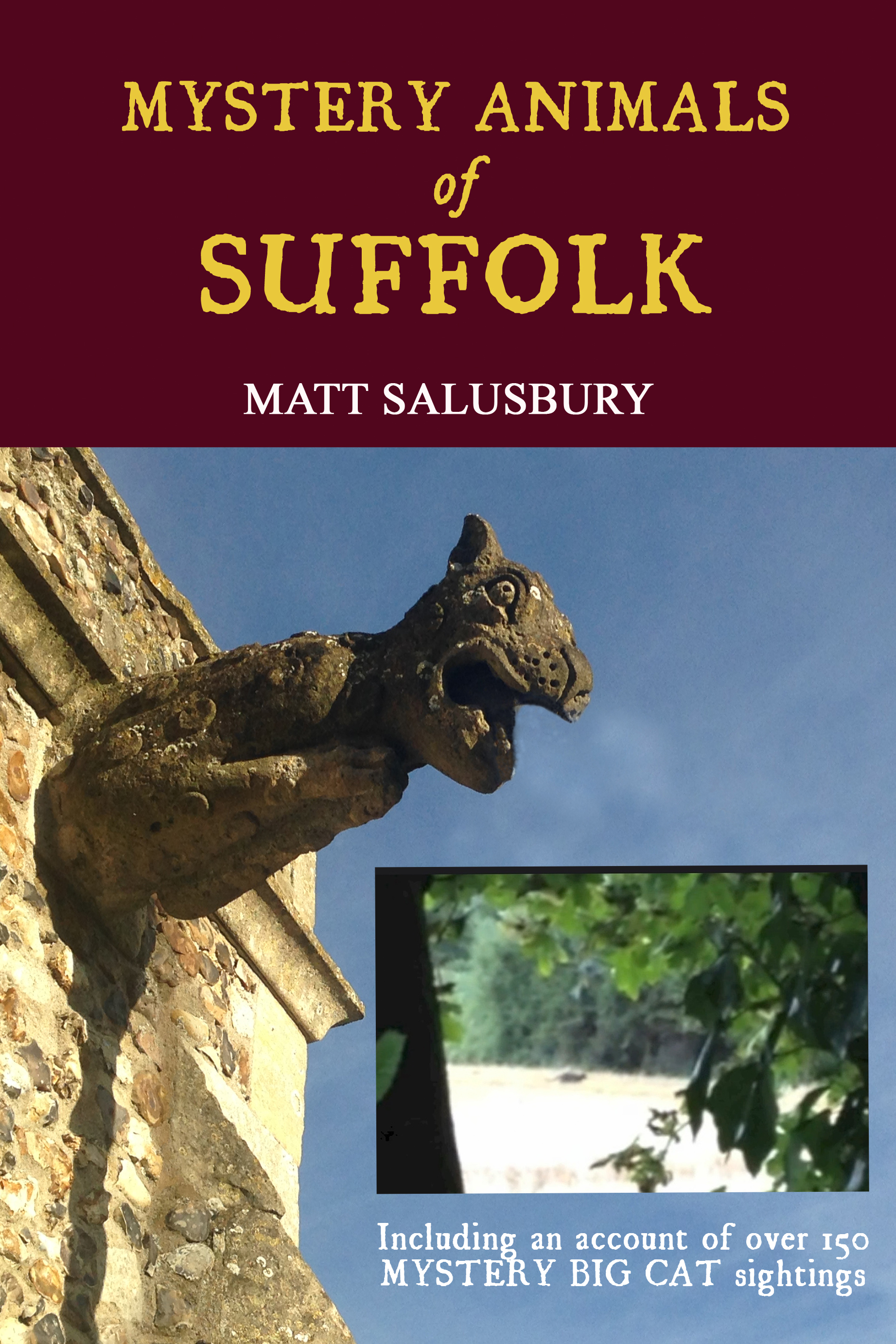
There's already a front cover. It shows a 15th-century panther gargoyle from St Peter's Church, Theberton
Oops! Better make that 2017! Sorry! "Author biography" from the current Fortean Times issue FT348, which includes my article on the Cutty Wren from Middleton, Suffolk
I've been asked for a progress report on my forthcoming and long-awaited book Mystery Animals of the British Isles: Suffolk.
Why has it taken so bloody long? Recent - now resolved - health issues aside, the flow of regular, paid-at-the-end of the-month work I can't turn down has rather got in the way. Also, when I started on the book at the end of 2014, I foolishly imagined big cats weren't really a big thing, and that a short section of big cats in the book might turn out to be a bit disappointing. Well over 170 reported or recorded Suffolk big cat sightings later, going back to 1974, this has turned out not to be the case!
My map of Suffolk showing nearly all the locations in the book, I'm about to add the big cat sightings!
I've been laying out the book myself, and I have the following still to do: one more illustration, some maps (a completed one is below, it needs some tweaks as it was bit faint on a test-print), bibliography, adding page numbers to the index and contents pages, finding some space to squeeze in some last-minute big cat reports if possible, moving around some pages in the layout, back cover illustration and then all done. At that point, hopefully soon, I will have some proofs to go to the proofreaders, and to Fortean Times co-editor Paul Sieveking, who is writing a short foreword. (He was born and bred in Snape, it turns out.)
There will be a book launch when the book's out, in Ipswich. To get on the "guesty" (guest list), email mysteryanimalsof suffolk@gn.apc.org. There are other Suffolk events around Mystery Animals planned, Moyse's Hall Museum, Bury (Bury St Edmunds) and Dunwich Reading Room are already interested.
Meanwhile, announcements are on the Twitter account at @MysteryAnimals
A tongue-in-cheek take on the fate of the Beccles Lynx, shot in Great Witchingham in 1991, found in a freezer in Beccles by Defra and Norfolk Police, and rumoured to be on display in a stately home somewhere in the Beccles area (there are lots of them!).
Update (2024): my book has now been published as Mystery Animals of Suffolk, available from bigcatsofsuffolk.com or via its distributor Bittern Books.
Labels:
Alien Big Cats,
Big Cats,
cryptozoology,
mystery animals,
Suffolk
Monday, 23 June 2014
Weird Weekend, "Tooth of enigmatic origin" crowdsourced identification

Archives de Zoologie Experimentale et Generale, 4th series, volume VII, October 1907 (for non-commericial purposes)
Copyright Horniman Museum & Gardens, used with permission. THe specimen at the bottom is accession no. NH.A3008
The "Tooth of enigmatic origin" in the drawing at the top was found in the ivory market at Addis Ababa in 1904 by Maurice de Rothschild's East Africa expedition will be the subject of my talk at Weird Weekend 2014 this August. See the programme for Weird Weekend 2014.
I'm on at 12 noon on Sunday 17 August, so if you're going, don't go getting too much of a hangover on Weird Saturday. For background, see my short article on the "enigmatic" tooth here.
My talk is down on the programme as "Baron Maurice de Rothschild's dionthere caper". At the time CFZ director Jon Downes and I put together the "pitch" for the talk, an article in the journal La Nature from 1910 suggested the "tusk of enigmatic origin" resembled that of a long-extinct group of elephant relatives, the dinotheres. Closer examination shows a misidentification may have been at work. Jon and I agreed to keep the title, it may not be a dinothere anymore but it's still a caper.
The original title for the talk had the wrong Rothschild - Walter, he of the zoo at Tring, and not Maurice (better known for racehorses, his art collection and being a Senator of the Republic of France.) As I plough slowly through the 50+ pages of the original French that is "Tooth of enigmatic origin", it has become apparent that Walter Rothschild does feature after all. He expressed enthusiasm for Maurice's find, and reportedly gave a presentation on this to the Zoological Society of London in September 1905. The ZSL library are on the case, but it's all still on card indexes so it'll take a while.
As a result of a Twitter appeal some crowdsourced identification of the "enigmatic" tooth has come in from three zoologists and a professor of paleonotology. I don't want to give away too much away ahead of the Weird Weekend talk, except to reproduce here, by kind permission of Paolo Viscardi, natural history curator at the Horniman Museum & Gardens, a photo (above) of their specimen of a walrus tusk (bottom of photo) compared to a hippo tooth (top of photo).
Meanwhile, there was a report on Maurice de Rothschild's East Africa expedition in book form, Voyage du Baron Maurice de Rothschild en Afrique orientale 1904–1905, and a very rare English language edition, Maurice de Rothschild’s Journey to East Africa 1904–1905. This is so rare that the British Library don't have a copy, the only place that has it is the Rothschild Archive in the City of London.
(Fortean Times are interested in a short "Forum" piece on this.)
Monday, 14 October 2013
There Be Beasts - report on London Cryptozoology Club's first conference - April 2013

Locals in a village in Burma with Richard Thorns's pink-headed duck lure. Photo: copyright Richard Thorns used with permission
This article first appeared in Fortean Times FT 302. Following a letter to Fortean Times from Paolo Viscardi, I have corrected a conflation of two different stuffed mermaids that appeared in the original article, this passage is indicated in bold type.
It was a full house in the basement at Treadwell's "esoteric beliefs" bookshop in Bloomsbury for There Be Beasts, the first London Cryptozoology Club (LCC) mini-conference in April. Treadwell's had helped out at the eleventh hour after the original venue fell through. James Newton, founder of the LCC and one of the conference's organisers introduced the day's proceedings before allowing
Richard Freeman, zoological director of the Centre for Fortean Zoology, to kick off, resplendent in a waistcoat emblazoned with gold dragons. His pet hate is Hollywood's tendency to depict dragons as having only two legs, when they should have four. The two-legged versions aren't dragons, they're wyverns, says Richard. "People who put wyverns in films and pass them off as dragons" drive "cryptozoological pedants like me" into a murderous rage.
He reeled off a list of mystery animals, a list that until 1904 would have included the gorilla, then regarded as just "a hairy ogre from 'native' folklore." Richard feels that Gigantopithecus – a huge fossil Asian ape whose fragmentary remains suggest it walked upright – is a good candidate for the identity of a current cryptid, the yeti.
Richard Freeman at previous talks - CFZ's Weird Weekend 2006 (above) and the Fortean Times UnConvention 2010 (right)
While earlier researchers perceived Bigfoot – North America's manimal – as an ape akin to Gigantopitchecus, "armchair cryptozoologist" James Newton introduced us to current trends in Bigfoot research, which suggest we're dealing with something much closer to us humans. James worked as a volunteer at South Dakota's Cheyenne River Youth Project with the Cheyenne River Sioux Tribe, a division of the Lakota Nation. Over twenty years of experience in youth work means he's good as spotting when children are trying to pull his leg, but he was struck by how Lakota kids he worked with described their attitudes and encounters with Bigfoot in a matter-of-fact way. Like the time in 2006 when, out of the blue, a girl named Misti Bad Warrior pointed to an illustration of Chewbacca in a Where's Wally? book and said, "That's Bigfoot."

Self-described "armchair cryptozoologist" James Newton, pictured when he was a youth worker with the Cheyenne River Sioux Tribe division of the Lakota Nation in South Dakota. Photo by kind permission of James Newton
Recent takes on Bigfoot, by the likes of researchers Autumn Williams – herself a childhood Bigfoot witness – and the "Tennessee Bigfoot lady" Mary Green, describe "habituation scenarios" – years of interactions between rural families and Bigfoot communities. The witnesses "were people who lack the sophistication to make it in cities… but were tuned in to their environment". Encounters could take the form of gift exchanges – missing animal feed, "artwork" gifts like knotted stalks of grass left in return, or a mother looking out of the kitchen window to see their child handing some biscuits over the fence to their "big hairy friend".
Suburban south London's Horniman Museum has in its collection a specimen known as "Japanese Monkey-Fish; Merman (Ningyo)." The Horniman's natural history curator, Paolo Viscardi,took us through an "unnatural history of mermaids."
It seems that in nineteenth century Japan, small representations of nature spirits were made – from a monkey and a fish – for shrines. When the first Western sailors turned up at Nagasaki, Japan's only trading port, a of monkey-fish mermaid cottage industry grew in response to demand.
Everyone assumed the Horniman mermaid, and all other mermaid "gaffes", were made from the head, arms and torso of a monkey sewn on to the back end of a fish. It transpired the Horniman "monkey fish", while it probably the back end of a carp, has no monkey parts at all. It has wire for fingers, a clay and papier-mâché head, fish jaws, bamboo neck, arms of wood and wire. Under X-rays or put through medical scanners, most "monkey-fish" mermaids display an absence of actual monkey bits. Leiden's small mermaid known as the Blomhoff Specimen can be traced to one of the nineteenth century trade fairs that took place around Nagasaki, but an extant mermaid specimen from India seems to be the only known still extant example of a mermaid that actually contains monkey body parts.
Richard Thorns, the "pink-headed duck guy" has been on three trips to Burma in search of that elusive bird – a large, mallard-sized diving duck with a long, ramrod-straight neck, chocolate brown in colour with a "bubble-gum pink" head (a gentler pink in the females). The duck was shy and solitary, preferring deep pools in wetlands. We're unsure if it was a species of pochard or a genus all of its own. It was always a rare bird, regarded from the early days of the British Raj as "a good day's bag." A 1920s captive breeding programme in Surrey failed, and the last recorded pink-headed duck (P-HD) was seen in 1935, in the north Indian state of Bihar. The wetland habitats around India's mega-cities have gone the same way as the pink-headed duck, but numerous marshes resembling those "vanished ecosystems" still exist over the border in Burma. "How could you possibly not want to go after that?" asked Richard.
His first Burma trip took Richard to Kachin State, three days upriver from Mandalay. You "can only stay at approved hotels" in Burma, so he had to use the services of a clandestine guide who had to hurry home when news came that "Immigration" were questioning his wife. In Richard's video interviews with locals, the camera's often pointed to the ground. People apparently didn't want to be photographed. Eventually, witnesses reported two P-HD sightings at one lake, and Richard heard about an unconfirmed sighting – lasting only a few seconds – by a Dutchman atop a hired elephant during a 2003 expedition to a lake at Naung Kwin. One fisherman said of the mystery duck, "it was here once." A broken hand from a motorbike accident cut short Richard's most recent expedition, while the Kachin Independence Army insurgency meant "unauthorised contact with foreigners" would land his guides in jail. He thinks one of the photographs he took just might show a P-HD on the lake. Time may be running out for the duck, if it does still live in Burma. Saffron and mustard cultivation are encroaching on the wetlands. Says Richard, "if Burma opens up, it would be very bad news for the pink-headed duck."
London Fortean Society coordinator Scott Wood described the legendary parakeets of London and friends. (The "friends" include the brand new Fordham Park panther – sighted by a woman in a street of that south London neighbourhood earlier that week.) Ring-necked parakeets are now endemic to a 30-kilometre stretch of West London (and Ramsgate), while South London is home to the Monk parakeet. Scott's fascinated by the urban legends and far-fetched "escape scenarios" surround the parakeets' arrival in the capital. These include Jimi Hendrix's two parakeets escaping from his Portobello Road flat at the moment of his death, fugitives from the Twickenham aviary of the exiled King Manuel the Unfortunate of Portugal, (still commemorated in Twickenham's Manuel Road,) break-outs during the filming of Anthony and Cleopatra and/or The African Queen at Shepperton Studios – except the later was filmed in Isleworth. Parakeet lore has turned the birds into a metaphor for immigration panic, a celebration of London's multiculturalism or a harbinger of global warming. The problem with these "scenarios" is that a DEFRA report says parakeets have been kept in English captivity since 1855, and are known to have been "naturalised" by 1960, before the demise of Hendrix.
James said of There Be Beasts that it "proved far more successful than we had imagined. We are hugely thankful to the speakers who gave their time and knowledge for free." There are plans afoot for "a bigger event in 2014" and for a summer LCC expedition to Dorset, in the company of "large cat" expert Jonathan McGowan, searching for traces of British Big Cats.
Barry Tadcaster, compere at the Centre for Fortean Zoology's Weird Weekend 2012, shown here with his partner in crime Orang Pendek. Several attendees pointed out Tadcaster's uncanny resemblance to Richard Freeman in a fez. Photo copyright Matt Salusbury
Since this article appeared in Fortean Times, I've spotted a parakeet in Clissold Park, Stoke Newington, London N17 - much further east than London parakeets have been reported before. And I've heard - but not yet seen - parakeets even further east, in London's Victoria Park.
The LLC is on Twitter: @WeAreTheLC
email: london.cryptozoology@gmail.com
© Matt Salusbury
Friday, 14 June 2013
Big cats in Dorset - London Cryptozoology Club expedition, with Jonathan McGowan
Jonathan McGowan (above, with sika deer pelvis fragment which he says bears teeth marks from a Big Cat) is a Big Cat consultant familiar to readers of this blog from his talks at CFZ's Weird Weekend, kindly hosted myself and two others from the London Cryptozoology Club (LCC) in early June on one of his regular Big Cat surveys with the Dorset Big Cats Group.
He is a naturalist and works at Bournemouth Science Society, and also does taxidermy. (McGowan said he was busy with taxidermy at the moment, most of it restoring hundred-year-old museum exhibits. The century-old sea eagle he was restoring for the Dorset County Museum had to be moved off one of the armchairs when the LCC rendezvoused at his Bournemouth home.) To his dismay, McGowan's most famous for his roadkill diet, which accounts for all the meat he eats, and has seen him interviewed on TV and radio shows in the US and Russia.
While the leopards reported in the UK used to be almost exclusively melanistic (black) leopards, now we're seeing "more spotted ones," says McGowan. The "leopard wool" (below, the under-layer of fur) we later picked off the barbed wire fences at Purbeck was from a spotted leopard.
Most people taking the chain ferry from Bournemouth over the estuary head straight for Shell Bay Beach (below, famous for its nudist colony) but few beach-goers are aware that there are "leopards on the beach at night."
A short drive inland took us the Purbeck Reed Beds (below) and other locations nearby that I was requested to be vague about, suffice to say there's absolutely nobody about and very few signs of any people having been there recently. The tourists driving through, however, were enough to make the Big Cats go to ground for the summer, and all the signs of them that we found were in McGowan's opinion at least a couple of weeks old.Apart from a couple of seaside towns in the way, there's a wildlife corridor along the south coast from here all the way to Devon and Cornwall.
The Big Cats in the Purbeck Reed Beds, a wilderness of heathland and lakes where we went, take one of two deer a week each, according to McGowan. He says that this is less than the "three to four deer a week run over on the roads" he routinely finds, with more deer lost to car collisions than to Big Cats. Roads sometimes act as territorial boundaries - where we went was the territory of a "small female" ("she's been here at least six years" (according to McGowan) and her cubs, which overlapped with a large male. McGowan and his arborealist friend (see below) recently found "fist-sized" prints of a big male leopard in soft ground.
We did find some prints of a small female leopard (below). McGowan says leopards avoid walking on soft ground where possible, as they don't want their tracks to alert people to their existence.
Leopard territories in Purbeck overlap with puma territories too, and McGowan told us he'd found evidence of a fight between a leopard and a puma, with bits of two different types of fur.
We found leopard scat (poo, below) lying around on the ground almost as soon as we got out of the car. At two weeks old, the action of the summer sun and rain on it means that the the scat crumbles into mostly clumps of deer hair and few beetles (yes, leopards also eat these) when handled. Leopards always mark their trails with scat, "sometimes every 100 yards," except for female leopards when they were with cubs, in which case they would bury it.
Big cats also make fastidious "scrapes" - scratch-marks in the ground laced with scent from their urine, which they use to mark territory. The scrapes are made with their hind feet and end with a little pile of earth. We saw several of these.
At Purbeck we were joined by an arborealist who helps out McGowan on his Big Cat surveys, and who subsequently made it clear he was ticking the "no publicity" box, so I've not named him. Of the British Big Cat phenomenon he said, "This isn't a joke, this is real."
McGowan also pointed out different-looking fox poo and otter scat (below) - this has the telltale sparkling fish scales. McGowan says the Big Cats eat otters, and badgers.
The deerstalkers around Purbeck apparently aren't being very effective, as McGowan says he's been out in the reed beds at dusk and seen herds of over a hundred sika deer, the preferred food of the Big Cats. We saw some of these from a distance, with their long necks and strange, squeaky calls. We also came across a sika deer fawn hiding from us in thick woodland. There were several spots where sika deer bones were scattered (littered with the remains of several skeletons on one case). Several bones bore evidence of having been nibbled by the teeth of a cat (example below). While dog and fox teeth puncture holes in bones and break them up, only the carnassial teeth of a Big Cat can make the clean cuts to bones that McGowan pointed out to us.
There's one concealed clearing at the edge of woodland (with sika deer bones) that McGowan thinks might be an ambush site for leopards to wait for passing sika deer. We also went to a secret location to change the memory card on one of the camera traps that McGowan's associate had set up (below).
McGowan estimates that in the UK there are "leopards - a few hundred, puma the same, less lynx." The directors of some local wildlife Trusts are beginning to be open to Big Cats, he says, but the British Deer Society fear their jobs in deer management are "in jeopardy if they admit to" Alien Big Cats (ABCs). McGowan says there's evidence they're eating another introduced species, feral wild boar. He also said that some naturalists are coming to the opinion that brown hares, long thought to have been introduced by the Romans, might not have been introduced and may always have been native to southern England.
As McGowan's got a book coming out soon, I refrain from reporting on some of the information he gave us, the latest photos he showed us by Sarah Ramsden from Kent or the spotted leopard photo from "Miss Leggins", the recent "Gloucester footage" or the audio he played us of leopard roars in the very English countryside. McGowan's book is provisionally tilted The British Large Cat Phenomenon: The Dorset Enigma.
By a lake in Purbeck. Leopards are good swimmers, and can swim after deer to islands on the lake.
LCC people in a silver birch forest somewhere in the Purbeck area
The skull of a sika deer with what McGowan described as dents made by a Big Cat's teeth (dents just above the fissure running from the left right to the bottom left)
All photos and words copyright Matt Salusbury. This article was amended 06/08/13 to obscure a personal name and a place name. This was done at the request of one of those featured in the article.
Tuesday, 19 March 2013
‘There Be Beasts' The First London Cryptozoology Club Mini-Conference - 13 April
I'll be helping out at ‘There Be Beasts ....’, the London Cryptozoology Club Mini-Conference is on Saturday 13th April 2013
11am – 7pm (first presentation at 11.30)
Upstairs at The Old Kings Head, 47-49 Borough High Street, London, SE1 1NA
Tickets: £5 / £2 concessions (students, OAPs, people in receipt of benefits)
To register and purchase tickets please email london.cryptozoology@gmail.com or call James Newton on 07805 356461
Confirmed talks:
• “On the Track of Unknown Animals Worldwide” Richard Freeman, Zoological Director of the Centre for Fortean Zoology

Richard Freeman of the CFZ at the Fortean Times UnCon 2010
• “Mermaids: A Natural and Unnatural History” Paolo Viscardi, Natural History Curator and Mermaid Anatomist (works at the Horniman Museum).
• “Current Developments in Bigfoot Research” James Newton, self-confessed Armchair Cryptozoologist. This includes recent research suggesting that Bigfoot may be much closer to us humans than we thought, not a Gigantopithecus at all but a manimal with a culture and a language, that knows how to stay hidden!
• “Does the Pink-Headed Duck Still Survive in Burma?” Richard Thorns, Writer, Ornithologist and Explorer
• 'The Legendary Parakeets of London and Friends' Scott Wood, Co-organiser of The London Fortean Society
Getting here: Nearest train: London Bridge (5 minutes walk)
Nearest tube: London Bridge (5 minutes walk)
Buses: 17, 21, 35, 40, 43, 47, 48, 133, 141, 149, 343, 381, 521, RV1
I've heard James Newton, Richard Freeman and Richard Thorns speak on these topics, all recommended!
See here for London Crytozoology Club's sceptical, pub-based "Tunbridge Wells Bigfoot" investigation earlier this year.
11am – 7pm (first presentation at 11.30)
Upstairs at The Old Kings Head, 47-49 Borough High Street, London, SE1 1NA
Tickets: £5 / £2 concessions (students, OAPs, people in receipt of benefits)
To register and purchase tickets please email london.cryptozoology@gmail.com or call James Newton on 07805 356461
Confirmed talks:
• “On the Track of Unknown Animals Worldwide” Richard Freeman, Zoological Director of the Centre for Fortean Zoology
Richard Freeman of the CFZ at the Fortean Times UnCon 2010
• “Mermaids: A Natural and Unnatural History” Paolo Viscardi, Natural History Curator and Mermaid Anatomist (works at the Horniman Museum).
• “Current Developments in Bigfoot Research” James Newton, self-confessed Armchair Cryptozoologist. This includes recent research suggesting that Bigfoot may be much closer to us humans than we thought, not a Gigantopithecus at all but a manimal with a culture and a language, that knows how to stay hidden!
• “Does the Pink-Headed Duck Still Survive in Burma?” Richard Thorns, Writer, Ornithologist and Explorer
• 'The Legendary Parakeets of London and Friends' Scott Wood, Co-organiser of The London Fortean Society
Getting here: Nearest train: London Bridge (5 minutes walk)
Nearest tube: London Bridge (5 minutes walk)
Buses: 17, 21, 35, 40, 43, 47, 48, 133, 141, 149, 343, 381, 521, RV1
I've heard James Newton, Richard Freeman and Richard Thorns speak on these topics, all recommended!
See here for London Crytozoology Club's sceptical, pub-based "Tunbridge Wells Bigfoot" investigation earlier this year.
Labels:
bigfoot,
cryptozoology,
London Cryptozoology Club
Friday, 8 March 2013
Does one and a half million deer mean more food for Britain's Big Cats?
A recent study by the University of East Anglia into deer population in Thetford Forest on the Norfolk/Suffolk border reveals the UK deer population is much bigger than previous believed - as many as one and a half million. This is reaching population levels not seen since the Ice Age. While it's been covered a lot in the news of late, so far I haven't come across any discussion on the implications of this for Britain's "Alien Big Cat" population.

Bits of deer are among the items on Jonathan McGowan's stall showing evidence of British "Big Cat" kills that he's collected over the years
British "Big Cat" expert Jonathan McGowan (he prefers the term "large cat" to describe the predators at large in the UK, which aren't so alien anymore,) in a talk on Britain's "large cats" at last year's CFZ "Weird Weekend" conference, said "Deer are the key to big cats… Throughout Britain, wherever there are deer in large numbers, there a large cats." He mentioned sika deer in particular, which are "great breeders." Sika deer are now established in Norfolk, and are turning up occasionally in Suffolk, and Suffolk's wildlife and conservation people have been concerned for some years now that muntjac deer in particular are destroying the bluebells in the bluebell woods. Back in 2009, Dr Simone Bullion's The Mammals of Suffolk was already talking about "the triumph of the deer."
Further afield, roe deer have been reported living in an urban cemetery in Sheffield, and wild muntjac are occasionally seen on the very urban London Borough of Haringey's Parkland Walk.
An explosion in deer populations and a much bigger population of deer than we knew about would presumably mean that if there is a "large cat" breeding population established in Britain - with so many deer to feast on - it must be doing rather well! Could it be that the "large cat" population, with a greater food source than we thought, could itself be bigger than we imagined?
Apparently, the massive deer cull that's being suggested as a result of the UEA study - around 60 per cent of the total UK deer population is being proposed - won't help reduce numbers all that much. In the Thetford Forest, the study showed about 2,000 deer a year are being "pushed out" of the forest by population pressures. Dr Paul Dolman, lead author of the UEA study, interviewed on BBC Radio 4's Today programme yesterday (11/03/13,)said that where there are regular deer culls, the deer tend to move out of the area. (Wouldn't you?!)
So not only is the "large cats'" favourite food source much bigger than previously believed, but deer are colonising new areas - good news for Britain's yet-to-be-officially-confirmed "large cat" population.
Bits of deer are among the items on Jonathan McGowan's stall showing evidence of British "Big Cat" kills that he's collected over the years
British "Big Cat" expert Jonathan McGowan (he prefers the term "large cat" to describe the predators at large in the UK, which aren't so alien anymore,) in a talk on Britain's "large cats" at last year's CFZ "Weird Weekend" conference, said "Deer are the key to big cats… Throughout Britain, wherever there are deer in large numbers, there a large cats." He mentioned sika deer in particular, which are "great breeders." Sika deer are now established in Norfolk, and are turning up occasionally in Suffolk, and Suffolk's wildlife and conservation people have been concerned for some years now that muntjac deer in particular are destroying the bluebells in the bluebell woods. Back in 2009, Dr Simone Bullion's The Mammals of Suffolk was already talking about "the triumph of the deer."
Further afield, roe deer have been reported living in an urban cemetery in Sheffield, and wild muntjac are occasionally seen on the very urban London Borough of Haringey's Parkland Walk.
An explosion in deer populations and a much bigger population of deer than we knew about would presumably mean that if there is a "large cat" breeding population established in Britain - with so many deer to feast on - it must be doing rather well! Could it be that the "large cat" population, with a greater food source than we thought, could itself be bigger than we imagined?
Apparently, the massive deer cull that's being suggested as a result of the UEA study - around 60 per cent of the total UK deer population is being proposed - won't help reduce numbers all that much. In the Thetford Forest, the study showed about 2,000 deer a year are being "pushed out" of the forest by population pressures. Dr Paul Dolman, lead author of the UEA study, interviewed on BBC Radio 4's Today programme yesterday (11/03/13,)said that where there are regular deer culls, the deer tend to move out of the area. (Wouldn't you?!)
So not only is the "large cats'" favourite food source much bigger than previously believed, but deer are colonising new areas - good news for Britain's yet-to-be-officially-confirmed "large cat" population.
Labels:
Alien Big Cats,
British big cats,
cryptozoology,
deer,
large cats
Tuesday, 22 January 2013
Chasing shadows – London Cryptozoology Club's "Tunbridge Wells Bigfoot" expedition
Investigating a Tunbridge Wells mystery
In November last year, there were widespread news reports of a sighting of what became known as the Tunbridge Wells Bigfoot, a roaring, black hairy figure "eight feet tall" with red eyes that startled an eyewitness walking on The Common at night. London Cryptozoology Club decided to investigate.
It should be noted that we went to Tunbridge Wells with a very sceptical view of this so-called "Tunbridge Wells Bigfoot" (TWB) phenomenon. We were particularly sceptical of an online posting by "Greham S," who claimed that a courting couple on a bench in The Common had witnessed the "Ape-Man" back in World War Two. Greham S left no other identifiers, and didn't give his source. There was also said to be an encounter with the "Kentish Apeman" by Territorial Army soldiers in 1991 at Bluebell Hill, Kent, which they saw off by throwing stones at it. We were not expecting to find TWB, we felt that the answers, if any, were more likely to be in what they diplomatically call the "pyscho-social realm".
"Do Well, Doubt Not!" Motto on bridge near Tunbridge Wells station (click on the image to enlarge)
Our plans, such as they were, mostly involved going to the pub and asking locals if they'd seen anything odd. Sitting around the pub was particularly high on our list of priorities.
Light snow over Wellington Rocks
So myself, "Other Matt", Rosie and Dewey set off on a January morning, and (mis)adventures already came our way before we'd even hit the platform at (Royal) Tunbridge Wells. One of our number caused us to miss a train with a complicated transaction involving getting a few quid off his ticket on the basis of his Oyster season ticket, and I left my bag on the train and had to jump back in and get it before the doors closed. That's how intrepid we are in the London Cryptozoological Club!
Wellington Rocks on Tunbridge Wells Common
Someone had come all the way from Brighton to run his radio-controlled all terrain cars over Wellington Rocks
Sophisticated Metropolitan city slickers that we are, we naively imagined that Tunbridge Wells Common would be some well-manicured Home Counties park with beds full of flowers in orderly rows, and perhaps a boating lake or something. Google Maps didn't really indicate just how wild it is either. In my naivety I half expected to bump into prolific letter-writer Disgusted of Tunbridge Wells.
It turns out The Common is a 200-acre wilderness, with bogs and spooky dead trees and three rock formations – Wellington Rocks, beloved of BMX bandits – High Rocks and Toad Rocks (we didn't get to see the last one). It was extraordinarily bleak, not the sort of landscape I'd associate with the Home Counties. There was even a mysterious disused railway running through the woods on The Common.
An uphill struggle
After about an hour of up hill and down dale, along Hungershall Park (Hunger shall lead us to the pub!) and Cabbage Stalk Lane, we finally made it to the Beacon pub. On the way, we talked to one dog-walker whose little dogs were shivering in the cold, and when we said we were looking for Bigfoot he joked that we must have been to the pub already.
Winding roads on the Common
The excellent Beacon pub – near High Rocks - has in a stain glass window the coat of arms of the Harrison family, with hedgehogs on it (herrison in French) and two golden crescent moons with red in the middle. While some of us felt they might be something to do with the red eyes on the TWB, the waitress said, "We call them stuffed olives." Over drinks and food, we speculated on the rock formations and various "Stone Tape" theories about geological formations and faults having an influence on the human brain, making people see things.
Hedgehogs and "stuffed olives" (red eyes?) on the Harrison coat of arms (click on the image to enlarge)
There followed a brisk walk across The Common and back to the station, as it was getting dark and we did not want to be out on the Common in the middle of a winter's night. A follow-up expedition involving a night vigil was suggested as we took the train back to Charring Cross.
Night manoeuvres on the Common
The previous evening, I'd emailed Neil Arnold, the go-to guy for all things strange and cryptozoological in Kent, about our outing. The morning after our trip out of town, I got this email from him:
"Hi Matt, there is no Tunbridge Wells Bigfoot and I've had to spend the last few months trying to tell so many papers etc this. I have a piece in next month's FT [Fortean Times] regarding it. The report in question was dubious to say the least, and not sure why anyone would go chasing shadows around TW. The common is relatively small. All this has been investigated by myself over two years ago after reports of a monkey on the loose around 1949. I've just had published a book called Haunted Tunbridge Wells.Regards, neil."
Oh well, chasing shadows it may have been, but a fun time was had by all.
A strange, dark, vaguely human shape looms out of the dark on the Common!
London Cryptozoology Club investigate the Wellington Rocks
Text and photos copyright Matt Salusbury
update: 4 December 2022 - the song "Where's you car, Debbie?" by Tunbridge Wells-based punk duo Slaves is apparently based on the early 2010s Tunbridge Wells Bigfoot sighting. Its official video features an ape-like creature lumbering around in the dark. There's a glimpse of one of band reading a mocked-up Tunbridge Wells local newspaper with a "Bigfoot-Spotted" headline. There's a link here.
Monday, 16 July 2012
"Colloque Cryptozoolgie", Dinant, Belgium
This first appeared in Fortean Times, issue 290, July 2012. I have corrected the French-language spelling mistakes that appeared in the print article, and for which I apologise. (Thirty-year old French O Level, as alluded to in the report!)
Dinant local boy Adolphe Sax immortalised sitting on a bench in the street outside his former house
The Belgian town of Dinant lies at the foot of the Ardennes mountains and at the end of the railway line from Brussels. You've done Dinant in a couple of hours, taking in the grey, onion-domed church and the cable car ride to the citadel that dominates the town. Local boy Adolphe Sax, the inventor of the saxophone, is immortalised in bronze, sitting on a bench on the pavement with his instrument outside La Maison De Monsieur Sax, "more or less on the spot where his original house stood."
But I wasn't in this underwhelming small town in Belgium to pay homage to Monsieur Sax. I had come to Dinant for the annual "Colloquium of Cryptozoology" – a whole weekend of cryptozoology talks – in French!
The eleventh colloque de crypotozoologie was in a nearby hotel that had its own forest in its grounds. The colloque had long breaks for meals – with cherry beers and chocolate mouse because, "we are in Belgium, after all." Talks were generally a shortish 40 minutes or less – of which I was glad, seeing as they were in a foreign language in which I had only a 30-year-old O-Level.
The town of Dinant, onion-domed church on the River Meuse in the foreground, citadel built by the Dutch during their brief occupation of Belgium in the background
It was a cosy affair with less than forty attendees. Most punters hailed not from Belgium but from France – a mother and daughter from just outside Paris, two Parisians of Russian origin and a retired couple the way from Marseilles, another six hours by train after a change at Brussels. This made my Eurostar commute from London to "any Belgian station" (according to my ticket) look easy. I found those from the South of France easier to understand than the Parisians and Walloons, (Francophone Belgians) whose French was harder to follow.
"Any Belgian station"
Ornithologist Jean-Jacques Barloy kicked off proceedings, lecturing on (as far as I could tell!) "Audubon's mysterious birds." Apart from his better-known encounter with a huge "Washington's eagle" (FT 262), ornithologist and artist John James Audubon described in his 1839 masterwork Birds of America other birds unknown to science (FT222:42–44). These included the small-headed flycatcher, the carbonated swamp warbler, Cuvier's kinglet and Townsend's bunting.
The mystery bunting, based on a specimen sent to the Smithsonian by one John Townsend, may have been a more colourful bird that lost its pigment during its preservation or storage. Barloy says Audubon's mystery kinglets, warblers and flycatchers were down to his tendency to name birds based on their resemblance to bird families in Europe, when they were really nothing of the sort. These birds were "misidentified or confused" rather than unknown.
Chemist and telecommunications engineer Michel Raynal said reading about the "Florida Monster" in Charles Fort’s Lo! first got him into cryptozoology thirty years ago. The lack of concrete evidence for cryptids "poses a problem of proof", but Raynal gave examples of, "in the total absence of sightings," animals whose existence was correctly predicted before their eventual discovery.
Michel Raynal
Charles Darwin and Alfred Russell Wallace both noted that Madagascan orchids "each had a corresponding pollinating insect" but for the magic orchid Angraecum sesquiipedale, the pollinator was unknown. The 20cm nectar tubes sticking out of the magic orchid suggested that whatever pollinated it would need a proboscis around 25cm (11 inches) long. Wallace compared the "search for such a creature" with the then recent discovery of the planet Neptune – found by observing "perturbations" in other planetary orbits. Walter Rothschild discovered the mystery missing moth Xanthopan morgana praedicta ("predicted") in 1902, with a proboscis of the anticipated length.
The entire population of the small, dark brown Guyanan lizard Gymnopthalamus underwoodi is female. It reproduces pathogenically. Raynal said that many pathogenic lizard species started as hybrids between two sexually reproductive species, and a sexually reproducing lizard Gymnopthalamus speciousis was known from the same habitat. Some bits of DNA in G. underwoodi weren't in G. speciousis, allowing scientists to predict the DNA sequence of the missing species that hybridised to produce G. underwoodi – with considerable accuracy, as it turned out when the aptly-named lizard species Gymnopthalamus cryptus was finally discovered up in 1993.
Raynal also noted reports of rhinos from apparently rhino-free Gabon. The African nation of Gabon does, however, have some recently evolved ticks now feeding on a range of big mammals – bison, for example – but very similar to specialised rhino ticks. Rhinos ticks are, notes Michel, easier to produce than “testimonial proof”.
A selection of rhino ticks
Doctor of cinematography Florent Barrère looked at the now well-known giant squid, and the more dubious giant octopus or "kraken octopus", once believed to lurk somewhere off the Cote d’Azur. Pierre Denys De Montfort's 1802 Histoire Naturelle de Mollusces includes a "colossal octopus" along with De Montfort's drawing from an ex-voto in the chapel of St Omar in St Malo, Brittany, giving thanks for saving the life of a sailor threatened by a gigantic octopus.
De Montfort's drawing of a common octopus, suspiciously similar to his "kraken octopus"
In De Montfort's drawing, the octopuses' huge tentacles coil round the rigging of a ship. The problem is the De Montfort's is the only existing account or image of the ex-voto in the chapel, which was destroyed by Allied bombing in 1944. The ex-voto, possibly based on secondhand accounts collected from Dunkirk sailors by De Montfort, may never have existed. And elsewhere in Historie Naturelle de Mollusces there's a drawing of a common octopus looking exactly like its colossal cousin.
We were then treated to the "Belgian premiere" of Marie Voignier's documentary L’Hypothèse du Mokélé Mbêmbé – with English subtitles, hurrah! It follows a permanently glum Michel Ballot through the dense, noisy jungle of Congo Brazzaville in search of an alleged living dinosaur. Ballot has a remarkable resemblance to scary German actor Klaus Kinski. His appearance and demeanour lend an already odd enterprise that otherworldly quality familiar from the tense Werner Herzog/Klaus Kinski going-mad-in-the-jungle movies Fitzcorraldo and Aguirre: Wrath of God. Recommended! Ms Voignier (on the left, with Ballot on the right in this photo) couldn’t make it in person, nor did she provide any more information about her mysterious film, although she hopes to do so next year.
Sunday's talks started early so those with a train to catch in Paris could get there before French presidential election campaign madness gripped the city. The day opened with sixth-form college English teacher Alain Bonet. The fortean-tinged French blockbuster movie Le Pacte Des Loupes (The Brotherhood of the Wolf) inspired him to research the "Beast of Gévaudan" – the creature (or creatures) that terrorised a region of southwestern France from 1764. Several official hunts, some with thousands of royal dragoons, led to several courtiers and military men ending their careers when attacks resumed again, before these fizzled out three years later.
Bonet found a surprising number of original documents still survive from that era. Some attacks were recorded twice or mis-transcribed – one boy victim of La Bête became a girl in the next report of the same incident. From this data Bonet has drawn up "the definitive list" of La Bête's victims – 128+ attacks, 49+ attacks with wounds, deaths 104, total 281+. Most attacks were on girls or women, or males under 16 – men outdoors would have usually carried tools or weapons.
English teacher and Beast of Gévaudan enthusiast Alain Bonet
One of the two animals shot in hunts for La Bête was an "extraordinary wolf" but smaller, with too many teeth. Hybrid wolf-dogs and unlikely wolf-hyena hybrids were among the explanations offered. Bonet suggests La Bête was a wolf showing unusual behaviour, so startling that witnesses misidentified it. While there are records of attacks on humans by wolves in Belgium, Germany and Switzerland, these were definitely wolves, not a “bête exotique”. Contemporary France had more of these, such as la Bête de Toulon and la Bête de Cote’Azur.
Father of cryptozoology Bernard Heuvelmans was, of course, Belgian, and Catherine Gravet, doctor of literature at UMONS University in Brussels, examined the 25 different "argumentative techniques" Heuvelmans employed in his apparent mission to convert the world to his cryptozoological ideas.
Dr Gravet's revelations on Heuvelmans were more bizarre than any of the weekend's mystery animals. Heuvelmans regarded cryptozoology as "more important than oncology" – the study of cancers. He was disturbingly keen on indoctrinating "the youth" to his crypto-crusade. He sent Tintin's creator Hergé a dossier of cuttings and drawings – made by one of Heuvelman's several brief wives, an illustrator – of the yeti. This insinuated its way into Hergé's interpretation of the yeti in Tintin in Tibet. Heuvelmans used his influence to ensure that bestselling Belgian adolescent paperback thriller series Bob Morane (he's a secret agent who saves the world) included a Heuvelmans-quoting sidekick and a civilisation of tool-using yetis who join Morane in fighting the perfidious Chinese Communists.
Dr Catherine Gravet
The signature of Tintin's creator Hergé greets Eurostar arrivals at the top of the escalator at Brussels South Station
And another woman who was briefly Madame Huevelmans – Monique Watteau, aka Alica Lindburgh – channelled Heuvelman's eccentric mission to convert unbelievers to cryptozoology through a series of messianic "eroto-fantastique" novels.
There was one other Brit at the Dinant gig, marine biologist Dr Charles Paxton, and we both learnt an important French word that weekend – témoignages –"sightings". With Monsieur Bonet the English teacher translating into French, Dr Paxton told how he number-crunched data from sea monster accounts from 1758-2000. He concluded that the creatures seen were "closer than you'd get by chance alone", suggesting witnesses underestimated the distance they were from the animal. He put a two-metre high model of a "tall black monster" on Lake Windermere, and asked people to describe it. While it was actually 337 metres away, most people described it as 500 metres away.
Children proved "lousy witnesses" in Paxton's Windermere experiment, female witnesses "significantly underestimated" the upright object's size, "males slightly over-estimated" its height. This prompted much Gallic giggling and a joke by Monsieur Raynal in French, the only word of which I caught was "pénis."
Dr Paxton has also extrapolated from a curve of discoveries of marine animals over two metres in length since Linnaeus that there remain quite a few whales yet to be discovered. There are only two known marine reptiles "above two metres", the leatherback turtle and the estuarine crocodile (sea snakes aren't quite long enough to make the grade). This, concludes Dr Paxton, makes it "statistically unlikely" that any sea monsters out there yet to be discovered will turn out to be plesiosaurs or other reptiles.
Dr Charles Paxton, en Anglais!
Self confessed "Belgian bigfooter" Eric Joye is the director of Abepar asbl, the organisation that organises the colloque, although Eric pretty much is Abepar asbl. Eric ended the colloque with his account of his latest trip to British Columbia in search of the elusive hominid. He had already treated attendees to his impressions of sasquatch grunts, screams and calls over dinner. He described the chilling experience of hearing a sasquatch call, imitating it and getting a response. Although coyotes are also good mimics, and Eric once got a coyote yelp in response to his impressions, the sasquatch call was "recognisably not a coyote."
Eric Joye
The French-speaking crypto-scene seems more rigorous in its researches than its English-language equivalent, which is too often reliant on enthusiasm alone. At the Dinant crypto-gig, cryptozoology was seen as a discipline, not a hobby, with consideration given to "investigative tools and "the rules of evidence". And Francophone "cryptos" understood that you also have to write up your findings in a way that engages the reader. It's a pity so much Francophone crypto-literature, of an intimidatingly high standard, never crosses the language barrier.
Next year, Abepar asbl's director promises conference-goers Dinant's famous koek biscuits traditionally made in the shape of animals, churches and such – but custom-made in the form of a sasquatch footprint.
* "Cryptozoologia", Abepar asbl's website, is at http://www.cryptozoologia.eu, where there are proceedings from its conferences as (paid-for) downloads. The 12th colloque crytozoologie is in Dinant in April 2013.
* There's a five-minute video of this year's event here.
© Matt Salusbury
Dinant local boy Adolphe Sax immortalised sitting on a bench in the street outside his former house
The Belgian town of Dinant lies at the foot of the Ardennes mountains and at the end of the railway line from Brussels. You've done Dinant in a couple of hours, taking in the grey, onion-domed church and the cable car ride to the citadel that dominates the town. Local boy Adolphe Sax, the inventor of the saxophone, is immortalised in bronze, sitting on a bench on the pavement with his instrument outside La Maison De Monsieur Sax, "more or less on the spot where his original house stood."
But I wasn't in this underwhelming small town in Belgium to pay homage to Monsieur Sax. I had come to Dinant for the annual "Colloquium of Cryptozoology" – a whole weekend of cryptozoology talks – in French!
The eleventh colloque de crypotozoologie was in a nearby hotel that had its own forest in its grounds. The colloque had long breaks for meals – with cherry beers and chocolate mouse because, "we are in Belgium, after all." Talks were generally a shortish 40 minutes or less – of which I was glad, seeing as they were in a foreign language in which I had only a 30-year-old O-Level.
The town of Dinant, onion-domed church on the River Meuse in the foreground, citadel built by the Dutch during their brief occupation of Belgium in the background
It was a cosy affair with less than forty attendees. Most punters hailed not from Belgium but from France – a mother and daughter from just outside Paris, two Parisians of Russian origin and a retired couple the way from Marseilles, another six hours by train after a change at Brussels. This made my Eurostar commute from London to "any Belgian station" (according to my ticket) look easy. I found those from the South of France easier to understand than the Parisians and Walloons, (Francophone Belgians) whose French was harder to follow.
"Any Belgian station"
Ornithologist Jean-Jacques Barloy kicked off proceedings, lecturing on (as far as I could tell!) "Audubon's mysterious birds." Apart from his better-known encounter with a huge "Washington's eagle" (FT 262), ornithologist and artist John James Audubon described in his 1839 masterwork Birds of America other birds unknown to science (FT222:42–44). These included the small-headed flycatcher, the carbonated swamp warbler, Cuvier's kinglet and Townsend's bunting.
The mystery bunting, based on a specimen sent to the Smithsonian by one John Townsend, may have been a more colourful bird that lost its pigment during its preservation or storage. Barloy says Audubon's mystery kinglets, warblers and flycatchers were down to his tendency to name birds based on their resemblance to bird families in Europe, when they were really nothing of the sort. These birds were "misidentified or confused" rather than unknown.
Chemist and telecommunications engineer Michel Raynal said reading about the "Florida Monster" in Charles Fort’s Lo! first got him into cryptozoology thirty years ago. The lack of concrete evidence for cryptids "poses a problem of proof", but Raynal gave examples of, "in the total absence of sightings," animals whose existence was correctly predicted before their eventual discovery.
Michel Raynal
Charles Darwin and Alfred Russell Wallace both noted that Madagascan orchids "each had a corresponding pollinating insect" but for the magic orchid Angraecum sesquiipedale, the pollinator was unknown. The 20cm nectar tubes sticking out of the magic orchid suggested that whatever pollinated it would need a proboscis around 25cm (11 inches) long. Wallace compared the "search for such a creature" with the then recent discovery of the planet Neptune – found by observing "perturbations" in other planetary orbits. Walter Rothschild discovered the mystery missing moth Xanthopan morgana praedicta ("predicted") in 1902, with a proboscis of the anticipated length.
The entire population of the small, dark brown Guyanan lizard Gymnopthalamus underwoodi is female. It reproduces pathogenically. Raynal said that many pathogenic lizard species started as hybrids between two sexually reproductive species, and a sexually reproducing lizard Gymnopthalamus speciousis was known from the same habitat. Some bits of DNA in G. underwoodi weren't in G. speciousis, allowing scientists to predict the DNA sequence of the missing species that hybridised to produce G. underwoodi – with considerable accuracy, as it turned out when the aptly-named lizard species Gymnopthalamus cryptus was finally discovered up in 1993.
Raynal also noted reports of rhinos from apparently rhino-free Gabon. The African nation of Gabon does, however, have some recently evolved ticks now feeding on a range of big mammals – bison, for example – but very similar to specialised rhino ticks. Rhinos ticks are, notes Michel, easier to produce than “testimonial proof”.
A selection of rhino ticks
Doctor of cinematography Florent Barrère looked at the now well-known giant squid, and the more dubious giant octopus or "kraken octopus", once believed to lurk somewhere off the Cote d’Azur. Pierre Denys De Montfort's 1802 Histoire Naturelle de Mollusces includes a "colossal octopus" along with De Montfort's drawing from an ex-voto in the chapel of St Omar in St Malo, Brittany, giving thanks for saving the life of a sailor threatened by a gigantic octopus.
De Montfort's drawing of a common octopus, suspiciously similar to his "kraken octopus"
In De Montfort's drawing, the octopuses' huge tentacles coil round the rigging of a ship. The problem is the De Montfort's is the only existing account or image of the ex-voto in the chapel, which was destroyed by Allied bombing in 1944. The ex-voto, possibly based on secondhand accounts collected from Dunkirk sailors by De Montfort, may never have existed. And elsewhere in Historie Naturelle de Mollusces there's a drawing of a common octopus looking exactly like its colossal cousin.
We were then treated to the "Belgian premiere" of Marie Voignier's documentary L’Hypothèse du Mokélé Mbêmbé – with English subtitles, hurrah! It follows a permanently glum Michel Ballot through the dense, noisy jungle of Congo Brazzaville in search of an alleged living dinosaur. Ballot has a remarkable resemblance to scary German actor Klaus Kinski. His appearance and demeanour lend an already odd enterprise that otherworldly quality familiar from the tense Werner Herzog/Klaus Kinski going-mad-in-the-jungle movies Fitzcorraldo and Aguirre: Wrath of God. Recommended! Ms Voignier (on the left, with Ballot on the right in this photo) couldn’t make it in person, nor did she provide any more information about her mysterious film, although she hopes to do so next year.
Sunday's talks started early so those with a train to catch in Paris could get there before French presidential election campaign madness gripped the city. The day opened with sixth-form college English teacher Alain Bonet. The fortean-tinged French blockbuster movie Le Pacte Des Loupes (The Brotherhood of the Wolf) inspired him to research the "Beast of Gévaudan" – the creature (or creatures) that terrorised a region of southwestern France from 1764. Several official hunts, some with thousands of royal dragoons, led to several courtiers and military men ending their careers when attacks resumed again, before these fizzled out three years later.
Bonet found a surprising number of original documents still survive from that era. Some attacks were recorded twice or mis-transcribed – one boy victim of La Bête became a girl in the next report of the same incident. From this data Bonet has drawn up "the definitive list" of La Bête's victims – 128+ attacks, 49+ attacks with wounds, deaths 104, total 281+. Most attacks were on girls or women, or males under 16 – men outdoors would have usually carried tools or weapons.
English teacher and Beast of Gévaudan enthusiast Alain Bonet
One of the two animals shot in hunts for La Bête was an "extraordinary wolf" but smaller, with too many teeth. Hybrid wolf-dogs and unlikely wolf-hyena hybrids were among the explanations offered. Bonet suggests La Bête was a wolf showing unusual behaviour, so startling that witnesses misidentified it. While there are records of attacks on humans by wolves in Belgium, Germany and Switzerland, these were definitely wolves, not a “bête exotique”. Contemporary France had more of these, such as la Bête de Toulon and la Bête de Cote’Azur.
Father of cryptozoology Bernard Heuvelmans was, of course, Belgian, and Catherine Gravet, doctor of literature at UMONS University in Brussels, examined the 25 different "argumentative techniques" Heuvelmans employed in his apparent mission to convert the world to his cryptozoological ideas.
Dr Gravet's revelations on Heuvelmans were more bizarre than any of the weekend's mystery animals. Heuvelmans regarded cryptozoology as "more important than oncology" – the study of cancers. He was disturbingly keen on indoctrinating "the youth" to his crypto-crusade. He sent Tintin's creator Hergé a dossier of cuttings and drawings – made by one of Heuvelman's several brief wives, an illustrator – of the yeti. This insinuated its way into Hergé's interpretation of the yeti in Tintin in Tibet. Heuvelmans used his influence to ensure that bestselling Belgian adolescent paperback thriller series Bob Morane (he's a secret agent who saves the world) included a Heuvelmans-quoting sidekick and a civilisation of tool-using yetis who join Morane in fighting the perfidious Chinese Communists.
Dr Catherine Gravet
The signature of Tintin's creator Hergé greets Eurostar arrivals at the top of the escalator at Brussels South Station
And another woman who was briefly Madame Huevelmans – Monique Watteau, aka Alica Lindburgh – channelled Heuvelman's eccentric mission to convert unbelievers to cryptozoology through a series of messianic "eroto-fantastique" novels.
There was one other Brit at the Dinant gig, marine biologist Dr Charles Paxton, and we both learnt an important French word that weekend – témoignages –"sightings". With Monsieur Bonet the English teacher translating into French, Dr Paxton told how he number-crunched data from sea monster accounts from 1758-2000. He concluded that the creatures seen were "closer than you'd get by chance alone", suggesting witnesses underestimated the distance they were from the animal. He put a two-metre high model of a "tall black monster" on Lake Windermere, and asked people to describe it. While it was actually 337 metres away, most people described it as 500 metres away.
Children proved "lousy witnesses" in Paxton's Windermere experiment, female witnesses "significantly underestimated" the upright object's size, "males slightly over-estimated" its height. This prompted much Gallic giggling and a joke by Monsieur Raynal in French, the only word of which I caught was "pénis."
Dr Paxton has also extrapolated from a curve of discoveries of marine animals over two metres in length since Linnaeus that there remain quite a few whales yet to be discovered. There are only two known marine reptiles "above two metres", the leatherback turtle and the estuarine crocodile (sea snakes aren't quite long enough to make the grade). This, concludes Dr Paxton, makes it "statistically unlikely" that any sea monsters out there yet to be discovered will turn out to be plesiosaurs or other reptiles.
Dr Charles Paxton, en Anglais!
Self confessed "Belgian bigfooter" Eric Joye is the director of Abepar asbl, the organisation that organises the colloque, although Eric pretty much is Abepar asbl. Eric ended the colloque with his account of his latest trip to British Columbia in search of the elusive hominid. He had already treated attendees to his impressions of sasquatch grunts, screams and calls over dinner. He described the chilling experience of hearing a sasquatch call, imitating it and getting a response. Although coyotes are also good mimics, and Eric once got a coyote yelp in response to his impressions, the sasquatch call was "recognisably not a coyote."
Eric Joye
The French-speaking crypto-scene seems more rigorous in its researches than its English-language equivalent, which is too often reliant on enthusiasm alone. At the Dinant crypto-gig, cryptozoology was seen as a discipline, not a hobby, with consideration given to "investigative tools and "the rules of evidence". And Francophone "cryptos" understood that you also have to write up your findings in a way that engages the reader. It's a pity so much Francophone crypto-literature, of an intimidatingly high standard, never crosses the language barrier.
Next year, Abepar asbl's director promises conference-goers Dinant's famous koek biscuits traditionally made in the shape of animals, churches and such – but custom-made in the form of a sasquatch footprint.
* "Cryptozoologia", Abepar asbl's website, is at http://www.cryptozoologia.eu, where there are proceedings from its conferences as (paid-for) downloads. The 12th colloque crytozoologie is in Dinant in April 2013.
* There's a five-minute video of this year's event here.
© Matt Salusbury
Subscribe to:
Posts (Atom)