Showing posts with label mystery animals. Show all posts

Wednesday, 28 July 2021

West Suffolk bobcat escaped while being transferred to a zoo, FIOA disclosure reveals

Big cat investigators spend a lot of time out in the wild with trail cameras and the like, but we can get a fairly good idea of what's happening by way of British big cat activity via Freedom of Information Act (FOIA) requests, to the police and to local councils, for example. This FOIA disclosure involves a escaped male bobcat shot and injured in Suffolk, after he was apparently rescued by the RSPCA who passed him on to a rescue centre where he was rehomed.

FOIA disclosures in response to my requests have uncovered the circumstances of the escape. They also hint at a former owner of multiple big cats somewhere in West Suffolk transferring a large number of "Dangerous Wild Animals" out of their ownership in the course of 2020.

Bobcat in Fort Worth Zoo by Wikimedia user "Malcolm", Wikimedia Commons Licence

Bobcats (Lynx rufus) are North American wildcats, similar in appearance to Canadian lynxes to which they are closely related (there are known lynx-bobcat hybrids). Bobcats are smaller than lynxes – bobcats can be up to 125cm (49.2 inches) long . They share the lynx’s characteristic of having distinctive tufts on the end of their ears and short tails – the name “bobcat” comes from its short tail, the short tails of rabbits being "bob-tails" in American English.

A Dangerous Wild Animals (DWA) Licence is needed to keep bobcats in the UK – they need an enclosure built to a standard specified in the Act, subject to inspection, which needs to be monitored with CCTV cameras. The owner also needs public liability insurance against damage caused by the animal. Animals have to be microchipped as well.

DWA licences are issued by local authorities, who are also responsible for enforcement of the Dangerous Wild Animals Act is down to local councils. In the case of West Suffolk it’s done through their licensing department. West Suffolk is a recent merger of the two Districts of West Suffolk, which are in turn devolved administrations – Forest Heath and St Edmundsbury – that fall within the boundaries of the county of Suffolk.

Those who keep big cats (in the UK it seems to be overwhelmingly men) are aware that in the UK’s current austerity regime, the ability of cash-strapped local authorities to actually carry out any enforcement. As we will see, West Suffolk took action to seize that bobcat once they’d identified its owner – probably through its microchip which would be linked to his owner’s DWA licence – but once it became clear that the owner was selling or giving away all their big cats (see below), West Suffolk probably decided to let it go, they probably didn’t feel like going through the expense of prosecuting the owner for negligence or for failing to report an escape.

As someone who investigates big cats in Suffolk, I was alerted by one of my many sources to the fact that an injured bobcat had turned up at a vet’s "near Bury" (Bury St Edmunds, West Suffolk). The bobcat had been shot in March 2020 (during full-on Lockdown 1.0) by a farmer who’d lost a lot of chickens to something. They had apparently sought the advice of police, who advised him that the was within his rights to shoot at it to scare it away. I was shown photos of the injured bobcat in his huge pet carrier at the vet’s, also an X-ray showing pellets lodged in his front legs and one of his eyes. (I was shown the photos on the understanding that they were not for publication.)

I was also told that the vet’s assistant had by chance done their internship on a conservation project with Iberian lynxes in Spain, so treating a closely-related bobcat for its injuries was relatively straightforward for the team there. I cannot reveal the identity of the vet, other than to say there are so many vets "near Bury", Suffolk being a very agricultural county, that I can safely use the phrase "vet near Bury" without risk of identifying it.

The story broke shortly after, in an exclusive story in The Sun. This red-top daily is actually getting surprisingly good at covering big cat stories. Under the headline "Big Cat Rampage: Bobcat goes berserk and savages farmer's chickens after escaping owner before being shot and captured", The Sun of 24 March 2020, the story is online here. It revealed that West Suffolk Council had started in an investigation into the circumstances of the bobcat’s escape. On the basis of this information, I made a FOIA request to West Suffolk.

West Suffolk’s unnamed FOIA Coordinator was kind enough to pass on to me a series of emails, with the names and email addresses redacted in accordance with data protection regulations. Fortunately for me, they’d been a big slack at redacting the job title on some of these emails, a quick look at the RSPCA’s website confirmed that Animal Collection Officer is a job title from within the RSPCA. The injured bobcat had apparently come into the care of the RSPCA who took it to the vet and passed him on to an (unnamed) refuge centre where he was rehomed.

Here is West Suffolk’s correspondence with the RSPCA about the bobcat:

Correspondence between West Suffolk's licensing division and the RSPCA about rehoming a rescued, injured bobcat.
West Suffolk advises the bobcat's owner that they have seized it under the Dangerous Wild Animals Act

If I have understood the correspondence and the Sun story correctly, while waiting to find out if the bobcat would be claimed, either the RSPCA or the vet seems to have called up their contact who they would ring whenever there was a lynx or bobcat that needed fostering.

That’s right, if my information is correct, the RSPCA in West Suffolk has a number for a lynx fosterer that they regularly ring – suggesting that it’s a common enough occurrence that they have a lynx fosterer on standby. Ownership of lynxes and bobcats in West Suffolk – whether licensed or not – may be much more common than anybody thought.

West Suffolk’s Service Manager (Environmental Health) wrote to the bobcat’s owner. They advised the owner that the Council that as of 20 March 2020, they "have today seized... an injured bobcat belonging to you and kept under licence by you." The bobcat’s owner soon replied with an apology regarding this "unfortunate escape". (The disclosure confirmed it was the only DWA escape West Suffolk had on record.)

The bobcat's owner apologises for not having reported the escape earlier and admits that the animal had escaped while being transferred into a vehicle to be rehomed to a zoo.

The owner replied with a rather peremptory apology and the briefest of admissions that they had made an “error of judgement” in not reporting the escape of a bobcat. (As well as an error of judgement, it’s also a breach of the law, owners have a duty to report escapes and local authorities have a duty to record these. West Suffolk confirmed to me the bobcat on the loose was the only recorded DWA escape in their jurisdiction to date.

The owner explained, in a scene reminiscent of the opening of the original 1993 Jurassic Park film, that “the bobcat was being homed to a zoo when the escape happened, on loading the cat, he lurched forward with force and the carrier fell, hit the floor releasing the door, in which he then escaped.” The owner went on the say that "we have been rehoming all DWAL animals and will not be renewing our licence this year."

West Suffolk requests from bobcat's owner details of how many Dangerous Wild Animals Act notifiable animals they still have.
West Suffolk requests from the bobcat's owner an update on the wildcats that were in their possession.

There’s also correspondence between West Suffolk and another entity – possibly the bobcat’s owner – asking for data on their DWAs. From this it seems that whoever it was whose bobcat escaped near Bury was winding down their big cat keeping operation. They confirmed to West Suffolk that in the year up to May 2020 they’d offloaded two caracals, two bobcats, (plus the one that West Suffolk seized and the RSPCA rehomed), one serval and two jungle cats to at least one third party.)

Bobcat's owner provides information on the fate of their wildcats (including the injured bobcat), destinations of these are redacted.
West Suffolk asks the bobcat's owner if the jungle cats have gone to... (redacted).

By June 2020 the owner had confirmed that "all bobcats have been rehomed" (the Council had a list of four bobcats licenced to that individual.) The final email in the FOIA disclosure has the owner anticipating a visit from "licensing" to check that there were no longer being kept on the premises any DWAL animals for which a licence would be needed.

Former owner confirms all bobcats have been rehomed, and confirms that jungle cats have indeed gone to... (redacted).
Former owner confirms they will not be renewing their Dangerous Wild Animals Act licence

I am reminded of other evidence of there being more lynxes and bobcats than anyone realised in West Suffolk. I have heard accounts of strange screams coming from Thetford Forest, as well lynx sightings in West Suffolk, including one in Red Lodge. Around 2005, people regularly heard such screams around Santon Downham, and there was said to be a "lynx man" locally who "everybody knew" kept lynxes. There are legitimate lynx re-introduction programmes in progress in Europe at the moment – parts of Germany and the Czech Republic are re-introducing lynxes. While a plan for the re-introduction of lynxes into an enclosed area of Thetford Forest (Norfolk-Suffolk border) was rejected, a proposed lynx re-introduction in Aberdeenshire is going ahead. The "lynx man", if he existed, could have been breeding lynxes as part of such a programme, he would obviously want to keep such activities very low-key.

The Press Association’s investigation from 2016 showed that at the time there were Dangerous Wild Animals Act licences for seven lynxes and two bobcats in West Suffolk. These two bobcats would now seem to have been accounted for, one male rehomed by the RSPCA, the female rehomed to (redacted).

An RSPCA official has confirmed to me that "this is one of our jobs and the photos are ours" (the photos of the injured bobcats at the vet’s, as seen in the Sun story. I am in negotiations with the RSPCA about the possibility of getting permission to reproduce the photos.

My source in East Anglian animal rescue told me there are a lot of owners of exotic animals (monkeys, exotic reptiles and big cats in particular) who keep them under the radar and don't bother getting a licence for their animals, so unrecorded big cat ownership and escapes in the country may be more common than official data suggests.

Wednesday, 12 April 2017

Back cover image for Mystery Animals


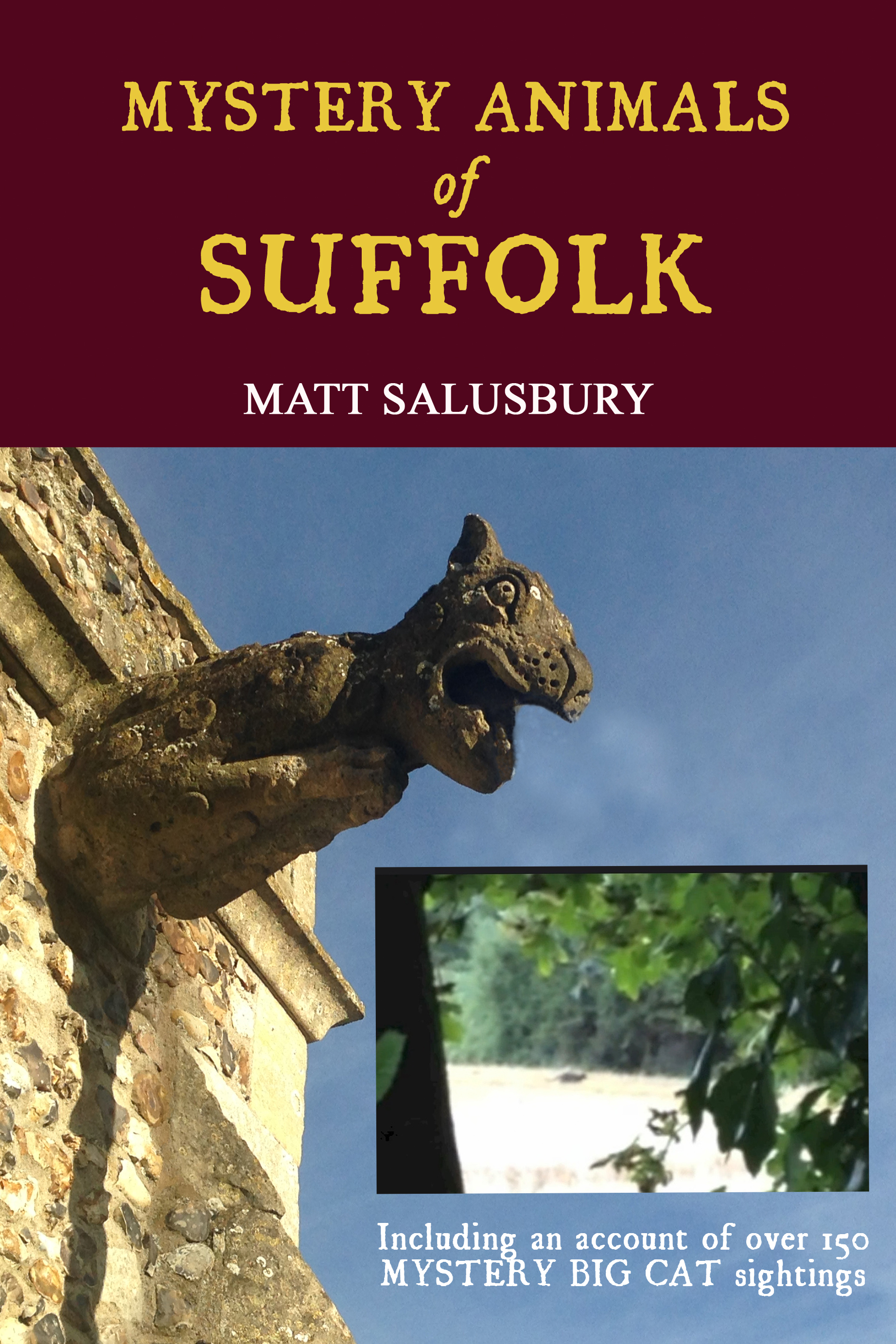
Here's a draft back cover image for Mystery Animals of the British Isles: Suffolk. It's waiting for some text, the CFZ logo and the ISBN bar code. All provisional, of course. There will be an explanation of the photos inside the back of the book. Copyright: Matt Salusbury 2017.


Update: My book has now been published as Mystery Animals of Suffolk, available from bigcatsofsuffolk.com or via its distributor Bittern Books.


Sunday, 18 December 2016

Mystery Animals of the British Isles: Suffolk - an update


The Hay Wain with Melanistic Leopard - with apologies to John Constable. Many of Suffolk's big cat reports come from the area of South Suffolk known as Constable Country along the Suffolk bank of the River Stour, on the border with Essex. Constable's original Hay Wain depicts Flatford Mill on the Suffolk bank of the Stour, seen from the Essex bank, not far from his birthplace at East Bergholt. Illustration from the forthcoming Mystery Animals of the British Isles: Suffolk


There's already a front cover. It shows a 15th-century panther gargoyle from St Peter's Church, Theberton


Oops! Better make that 2017! Sorry! "Author biography" from the current Fortean Times issue FT348, which includes my article on the Cutty Wren from Middleton, Suffolk

I've been asked for a progress report on my forthcoming and long-awaited book Mystery Animals of the British Isles: Suffolk.

Why has it taken so bloody long? Recent - now resolved - health issues aside, the flow of regular, paid-at-the-end of the-month work I can't turn down has rather got in the way. Also, when I started on the book at the end of 2014, I foolishly imagined big cats weren't really a big thing, and that a short section of big cats in the book might turn out to be a bit disappointing. Well over 170 reported or recorded Suffolk big cat sightings later, going back to 1974, this has turned out not to be the case!


My map of Suffolk showing nearly all the locations in the book, I'm about to add the big cat sightings!

I've been laying out the book myself, and I have the following still to do: one more illustration, some maps (a completed one is below, it needs some tweaks as it was bit faint on a test-print), bibliography, adding page numbers to the index and contents pages, finding some space to squeeze in some last-minute big cat reports if possible, moving around some pages in the layout, back cover illustration and then all done. At that point, hopefully soon, I will have some proofs to go to the proofreaders, and to Fortean Times co-editor Paul Sieveking, who is writing a short foreword. (He was born and bred in Snape, it turns out.)

There will be a book launch when the book's out, in Ipswich. To get on the "guesty" (guest list), email mysteryanimalsof suffolk@gn.apc.org. There are other Suffolk events around Mystery Animals planned, Moyse's Hall Museum, Bury (Bury St Edmunds) and Dunwich Reading Room are already interested.

Meanwhile, announcements are on the Twitter account at @MysteryAnimals


A tongue-in-cheek take on the fate of the Beccles Lynx, shot in Great Witchingham in 1991, found in a freezer in Beccles by Defra and Norfolk Police, and rumoured to be on display in a stately home somewhere in the Beccles area (there are lots of them!).


Update (2024): my book has now been published as Mystery Animals of Suffolk, available from bigcatsofsuffolk.com or via its distributor Bittern Books.


Monday, 23 June 2014

Weird Weekend, "Tooth of enigmatic origin" crowdsourced identification


Archives de Zoologie Experimentale et Generale, 4th series, volume VII, October 1907 (for non-commericial purposes)


Copyright Horniman Museum & Gardens, used with permission. THe specimen at the bottom is accession no. NH.A3008

The "Tooth of enigmatic origin" in the drawing at the top was found in the ivory market at Addis Ababa in 1904 by Maurice de Rothschild's East Africa expedition will be the subject of my talk at Weird Weekend 2014 this August. See the programme for Weird Weekend 2014.

I'm on at 12 noon on Sunday 17 August, so if you're going, don't go getting too much of a hangover on Weird Saturday. For background, see my short article on the "enigmatic" tooth here.

My talk is down on the programme as "Baron Maurice de Rothschild's dionthere caper". At the time CFZ director Jon Downes and I put together the "pitch" for the talk, an article in the journal La Nature from 1910 suggested the "tusk of enigmatic origin" resembled that of a long-extinct group of elephant relatives, the dinotheres. Closer examination shows a misidentification may have been at work. Jon and I agreed to keep the title, it may not be a dinothere anymore but it's still a caper.

The original title for the talk had the wrong Rothschild - Walter, he of the zoo at Tring, and not Maurice (better known for racehorses, his art collection and being a Senator of the Republic of France.) As I plough slowly through the 50+ pages of the original French that is "Tooth of enigmatic origin", it has become apparent that Walter Rothschild does feature after all. He expressed enthusiasm for Maurice's find, and reportedly gave a presentation on this to the Zoological Society of London in September 1905. The ZSL library are on the case, but it's all still on card indexes so it'll take a while.

As a result of a Twitter appeal some crowdsourced identification of the "enigmatic" tooth has come in from three zoologists and a professor of paleonotology. I don't want to give away too much away ahead of the Weird Weekend talk, except to reproduce here, by kind permission of Paolo Viscardi, natural history curator at the Horniman Museum & Gardens, a photo (above) of their specimen of a walrus tusk (bottom of photo) compared to a hippo tooth (top of photo).

Meanwhile, there was a report on Maurice de Rothschild's East Africa expedition in book form, Voyage du Baron Maurice de Rothschild en Afrique orientale 1904–1905, and a very rare English language edition, Maurice de Rothschild’s Journey to East Africa 1904–1905. This is so rare that the British Library don't have a copy, the only place that has it is the Rothschild Archive in the City of London.

(Fortean Times are interested in a short "Forum" piece on this.)


Tuesday, 22 January 2013

Chasing shadows – London Cryptozoology Club's "Tunbridge Wells Bigfoot" expedition


Investigating a Tunbridge Wells mystery

In November last year, there were widespread news reports of a sighting of what became known as the Tunbridge Wells Bigfoot, a roaring, black hairy figure "eight feet tall" with red eyes that startled an eyewitness walking on The Common at night. London Cryptozoology Club decided to investigate.

It should be noted that we went to Tunbridge Wells with a very sceptical view of this so-called "Tunbridge Wells Bigfoot" (TWB) phenomenon. We were particularly sceptical of an online posting by "Greham S," who claimed that a courting couple on a bench in The Common had witnessed the "Ape-Man" back in World War Two. Greham S left no other identifiers, and didn't give his source. There was also said to be an encounter with the "Kentish Apeman" by Territorial Army soldiers in 1991 at Bluebell Hill, Kent, which they saw off by throwing stones at it. We were not expecting to find TWB, we felt that the answers, if any, were more likely to be in what they diplomatically call the "pyscho-social realm".


"Do Well, Doubt Not!" Motto on bridge near Tunbridge Wells station (click on the image to enlarge)


Our plans, such as they were, mostly involved going to the pub and asking locals if they'd seen anything odd. Sitting around the pub was particularly high on our list of priorities.


Light snow over Wellington Rocks

So myself, "Other Matt", Rosie and Dewey set off on a January morning, and (mis)adventures already came our way before we'd even hit the platform at (Royal) Tunbridge Wells. One of our number caused us to miss a train with a complicated transaction involving getting a few quid off his ticket on the basis of his Oyster season ticket, and I left my bag on the train and had to jump back in and get it before the doors closed. That's how intrepid we are in the London Cryptozoological Club!


Wellington Rocks on Tunbridge Wells Common


Someone had come all the way from Brighton to run his radio-controlled all terrain cars over Wellington Rocks

Sophisticated Metropolitan city slickers that we are, we naively imagined that Tunbridge Wells Common would be some well-manicured Home Counties park with beds full of flowers in orderly rows, and perhaps a boating lake or something. Google Maps didn't really indicate just how wild it is either. In my naivety I half expected to bump into prolific letter-writer Disgusted of Tunbridge Wells.

It turns out The Common is a 200-acre wilderness, with bogs and spooky dead trees and three rock formations – Wellington Rocks, beloved of BMX bandits – High Rocks and Toad Rocks (we didn't get to see the last one). It was extraordinarily bleak, not the sort of landscape I'd associate with the Home Counties. There was even a mysterious disused railway running through the woods on The Common.


An uphill struggle

After about an hour of up hill and down dale, along Hungershall Park (Hunger shall lead us to the pub!) and Cabbage Stalk Lane, we finally made it to the Beacon pub. On the way, we talked to one dog-walker whose little dogs were shivering in the cold, and when we said we were looking for Bigfoot he joked that we must have been to the pub already.


Winding roads on the Common

The excellent Beacon pub – near High Rocks - has in a stain glass window the coat of arms of the Harrison family, with hedgehogs on it (herrison in French) and two golden crescent moons with red in the middle. While some of us felt they might be something to do with the red eyes on the TWB, the waitress said, "We call them stuffed olives." Over drinks and food, we speculated on the rock formations and various "Stone Tape" theories about geological formations and faults having an influence on the human brain, making people see things.


Hedgehogs and "stuffed olives" (red eyes?) on the Harrison coat of arms (click on the image to enlarge)

There followed a brisk walk across The Common and back to the station, as it was getting dark and we did not want to be out on the Common in the middle of a winter's night. A follow-up expedition involving a night vigil was suggested as we took the train back to Charring Cross.

Night manoeuvres on the Common


The previous evening, I'd emailed Neil Arnold, the go-to guy for all things strange and cryptozoological in Kent, about our outing. The morning after our trip out of town, I got this email from him:

"Hi Matt, there is no Tunbridge Wells Bigfoot and I've had to spend the last few months trying to tell so many papers etc this. I have a piece in next month's FT [Fortean Times] regarding it. The report in question was dubious to say the least, and not sure why anyone would go chasing shadows around TW. The common is relatively small. All this has been investigated by myself over two years ago after reports of a monkey on the loose around 1949. I've just had published a book called Haunted Tunbridge Wells.Regards, neil."

Oh well, chasing shadows it may have been, but a fun time was had by all.


A strange, dark, vaguely human shape looms out of the dark on the Common!


London Cryptozoology Club investigate the Wellington Rocks


Text and photos copyright Matt Salusbury

update: 4 December 2022 - the song "Where's you car, Debbie?" by Tunbridge Wells-based punk duo Slaves is apparently based on the early 2010s Tunbridge Wells Bigfoot sighting. Its official video features an ape-like creature lumbering around in the dark. There's a glimpse of one of band reading a mocked-up Tunbridge Wells local newspaper with a "Bigfoot-Spotted" headline. There's a link here.

Sunday, 20 May 2012

Big Cats - Facing Britain's Wild Predator - book review

Big Cats – Facing Britain's Wild Predator by Rick Minter, Whittles Publishing, 2011, £18.99, paperback, 214 pages, colour photographs

This review first appeared in Fortean Times magazine, issue FT289 , June 2012

They used to be Alien Big Cats (ABCs), although author Rick Minter's point is that they're no so alien anymore, and our acceptance of big cats as part of Britain's established natural fauna may be imminent. In view of all the evidence presented here and elsewhere, Britain's failure to accept there are big cats among us is a bigger mystery than the mystery big cats themselves.

Facing explains how extraordinarily hard it is even to photograph big cats in the wild. Most leopards you'll see in photos live in sanctuaries and are used to seeing humans. And it was only on its second Himalayan expedition, part of an effort costing as much as 'a small house in England,' that a film crew recently managed to shoot the first ever footage of snow leopards in a genuinely wild environment.

Never mind the photos, there's plenty of other evidence. Big cat poo apparently isn't that hard to find in the British wilderness, and there are numerous signs of cat kills and traces of their meticulous dismemberment and fussy eating of deer and sheep carcasses.

But Facing Big Cats isn't just about cats, it's about us humans and how we'd deal with an official admission that big cats are out there, and what are we going to do about it? Minter examines the implications of British big cats for conservation (his day-job), agriculture and other areas of policy.

Particularly striking among the book's numerous colour photos is the one showing Fairfax, an 'extraordinary specimen' of a black domestic cat 'from feral stock', sitting on an antique writing desk, his tail and paws protruding over both ends. Fairfax measured four feet from head to tail.

While feral moggies could somehow be reaching gigantic proportions, Minter suggests any next-generation black leopards loose in Britain could be getting smaller. He explains that the 'open savannah' leopards 'popular in zoos' tend to be the bigger ones, while 'wild tropical leopards from Asia are often small animals… under selective pressure to be small,' some only 70cm long, about right for the 'large Labrador-sized' big cats witnesses usually describe.

Minter doesn't just quote Britain's big cat experts - some will be familiar to FT readers: Chris Moiser, the CFZ's Jonathan McGowan, Big Cats in Britain's Mark Fraser – he takes the brave step of giving them two or three pages each to have their say, which works well. (See here for my write-up of talks by McGowan and Moiser on ABCs in Britain from 2007.)

Big Cats - Facing... is beautifully written with much love for the subject and lots of 'Wow! I never knew that' surprises. For example, Minter notes how Britain's otter population crashed almost to extinction in the early 1980s. After that, people reporting otter sightings to the wildlife authorities tended to be ignored, until they gave up reporting otter sightings altogether. Years later, surprised conservation managers announced otter numbers had 'suddenly' recovered. A similar phenomenon may be at work with big cats.

There's no index, but the layout and organisation of the coloured-ink sub-headings, checklists and bullet points means you hardly need one, and make this book ideal for 'dipping' into.


Jonathan McGowan's display of kills he found that were made by an "Alien Big Cat". Apparently the teeth-marks on these bones could only have been made by a Big Cat. Author's photo from McGowan's display at Weird Weekend 2009, the bones are of deer, sheep, etc.

VERDICT:10/10 – ALL BOOKS ON MYSTERY ANIMALS SHOULD BE LIKE THIS

© Matt Salusbury