Showing posts with label ABCs. Show all posts

Friday, 11 October 2019

A Roman carcal in Norfolk

This article first appeared in Fortean Times FT 382, August 2019


ONE explanations offered for sightings of big cats in Britain is “the escape theory,” the idea that British big cats are introduced exotics that escaped from menageries from Roman times onwards. (See FT 224;38).

A caracal, Image: Matt Salusbury


The problem with this idea is that there hasn’t been much evidence for historical escapes from circuses or menageries – the occasional escaped circus lion was usually quickly recaptured or shot.

Sure, the Romans had their circuses and wealthy Romans in Britain may have kept exotic big cats as pets. The huge Londinium amphitheatre under what’s now The Guildhall in the City of London had foundations showing signs of there having been a massive gates – and smaller sliding gates – suitable for releasing big animals into fights with gladiators in an arena that could have seated a quarter of Londinium’s population.

The Roman army included specialist venatores troops whose role included capturing wild animals, probably for the arena. Several Roman camps in Britain including Caerleon (Newport) had small arenas, more likely for the entertainment of the troops than for drilling. Venatores would have captured wild animals to be slaughtered before the crowds in local military arenas, their skins then being used for the headgear of legionary standard bearers.

We know venatores were active in Britain – the poet Martial describes seeing a Caledonian (Scottish) bear brought all the way to the Colosseum in Rome for its inaugural games. Mini-circuses involving animals – even imported ones – were cheaper to put on for the enjoyment of the legionaries than gladiatorial games. (“The Venatores – animal hunting in the army”, Duncan B Campbell, Ancient Warfare, Vol. XII, issue 5, Karwansaray Publishers, Rotterdam 2019.)

The bones of leopards have been found in a rubbish heap in Ancient Rome, with leopard remains unearthed in a Roman legionary camp in Dacia (modern Romania). The Emperor Gordian was recorded in AD 241 as having “60 tame lions” in his game parks around Rome, while The Augustan History, the Three Gordians, notes that “Caesar’s herd” had a facility to accommodate new arrivals at Laurentium, near the port of Ostia.

Most of the traffic in captured exotics, though, led to Rome rather than to the outlying province of Britannia. Homo Tyrannicus – A history of man's war against animals (Peter Verney, Mills & Boon, London 1979) recounts how the Eternal City’s demand for ventationes – combats between animals or between men and animals in the arena – all but wiped out African elephants in Tunisia and Libya during the Roman period. By the time of the birth of Christ, lions were rare in Libya and were later driven to extinction in much of North Africa and the Middle East to feed the games.


Venatores hunting a tiger from a mosaic in Istanbul, Wikimedia Commons

While ventationes continued right up to Rome’s final collapse, long after gladiatorial combats between humans had gone out of fashion, later Roman circuses featured huge herds of deer to make up the numbers. Circuses had by then already stripped the Empire of big cats and other exotics. As the Empire shrank, acquiring and bringing to Britannia whatever big cats remained in its territory became harder. The whole point of shipping over such animal was to kill them in front of a crowd. All this makes the prospect of exotic big cats surviving and escaping into the Romano-British landscape sometime before the legions abandoned the province in AD 410 a remote one. Nor is there any archaeological or documentary evidence.

Until now. Yes, that’s right, there’s new evidence for a big cat in Roman Britain. Well, not exactly a big cat, but an exotic introduced species of respectable-sized wildcat. The latest edition of The Annual – Bulletin of the Norfolk Archaeological Research Group (No. 27, 2018) includes “Some faunal remarks on the Aylesham Roman Project 2016/17 – a dog, a beaver tooth amulet and animal marks on tiles” by archaeologist Julie Curl. This looks at finds from the site of a Roman villa with a pottery and two kilns in Aylesham, Norfolk, excavated in 2016.

Here wet clay tiles were left out in the sun to dry, some ended up in a rubbish heap after various animals had walked over them and left their footprints in them – a pine martin, a European wildcat, newts and a small dog. One tile in particular has three toe marks of which Curl comments, “At this stage of the investigation, the prints compare well both in size and shape with the Caracal.” Lynxes survived in northern Britain until Saxon times (their range limited to further north than Norfolk) but Curl says the toe marks are “more oval” and slightly too pointed for a lynx. A caracal is the best match.

A caracal is a species of long-legged wildcat, easily twice the size of a domestic cat, red-brown in colour with long, elaborately tufted black ears (its name comes from the Turkish for “black ear”). Caracals now live in the wild in Africa and Asia. Turkey – where caracals are now very rare – is currently the nearest place to Britain to find them in the wild; their range in Roman times would have been greater.

Caracals are known to have been kept as pets by wealthy Romans; ancient Egyptian art shows caracals wearing collars. It’s not clear whether the caracal walking over tiles in Aylesham was a pet or a feral that had escaped, although most of the tracks found on the site were made by wild animals. Curl speculates that our Romano-British caracal could have been an “escaped pet, status symbol, performing animal or curiosity.” It wouldn’t have been impressive enough for the circus. While we know Romans used caracal pelts to make cloaks, its skin would also have been too small to end up as a standard bearer’s headdress.

The Dangerous Wild Animals Act requires owners to have a licence to keep a caracal, which needs to be on a lead and accommodated in a “secure outdoor area” with CCTV. In the days of the British Raj, normally solitary Indian caracals were trained to hunt in packs for birds or hares, but the drawback with caracals was they were reluctant to surrender their prey – they were never regarded as being all that tame. Caracals are, to put it mildly, a bit of handful for their owners. So a “pet” Romano-British caracal could easily turn into an exotic escapee.

Whether it was a pet or escapee, this discovery introduces something new and exciting to the “British big cats” controversy. Could there have been caracals loose in Roman times, and possibly later? 350 years of Roman occupation is enough time for an awful lot of caracal escapes.

The Mabinogian, a series of Welsh tales collected in the 11th century, describes a giant wildcat, the Cath Palug, or “scratch cat.” Could the descendants of the Roman caracal from Aylesham be it?


Could Romano-British caracals have hybridised with British lynxes, or with Roman domestic cats – more like African wildcats than today’s moggies – or with the European wildcats then endemic to England, injecting exotic genes into Britain’s feral cat or wildcat populations?

Hybrids of caracals and domestic Abyssinian cats have been recorded – they’re known as “caracats”, they’re still quite a lot bigger than domestic cats and have the luxurious tufted ears of the caracal, without their difficult temperament.

A 1997 census of exotic wildcats in the United States listed three hybrid cats of the “Caracal/Lynx” type. However, caracals (Caracal caracal) are sometimes called “caracal lynxes” or “African lynxes” because of their lynx-like tufts, although they are not that closely related to lynxes. Official publicity photos of an animal in London Zoo in the 1950s, for example, were captioned “caracal lynx” at the time.

Although caracals share with lynxes the tufted ears, caracals are actually in a distinct sub-family along with servals (Leptailurus serval) and African golden cats (Caracal aurata.) The Eurasian lynx (Lynx lynx) belongs to a different sub-order of the Felidae (cats) family than the caracals. Any “caracal lynx” hybrids are thought to be dubious and misnamed. (See the Messy Beast website.)


This is not an image of the footprint possibly of a caracal in Alyseham. For copyright reasons I do not have it. This photo shows the paw print of a domestic animal ona Roman tile from around Londinium in the London Museum. There's some interactive task that asks visitors to identify the animal, so I won't spoil it by revealing what it is

© Matt Salusbury 2019


Another Romano-British tile that has a footprint in it made while it was laid out on the ground to dry. This footprint was definitely made by a domestic cat in the bottom right of a fragmentary tile found in the excavation of a section of the city walls of Londinium, now on display at the City Wall at Vine Street museum.


Wednesday, 12 April 2017

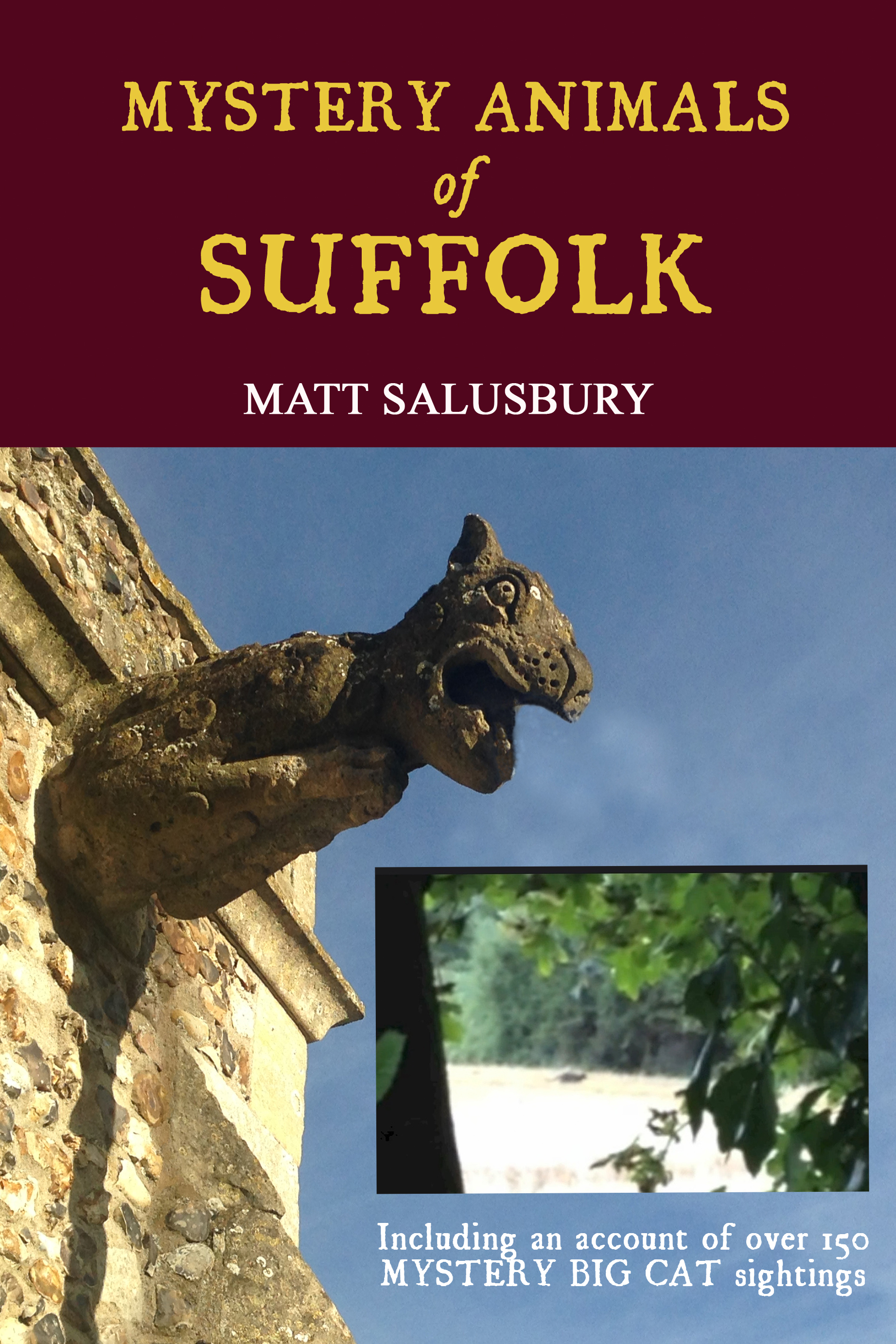
Back cover image for Mystery Animals


Here's a draft back cover image for Mystery Animals of the British Isles: Suffolk. It's waiting for some text, the CFZ logo and the ISBN bar code. All provisional, of course. There will be an explanation of the photos inside the back of the book. Copyright: Matt Salusbury 2017.


Update: My book has now been published as Mystery Animals of Suffolk, available from bigcatsofsuffolk.com or via its distributor Bittern Books.


Sunday, 23 November 2014

Appropriate Big Cat Investigator headgear, and finally face-to-face with Wool I Am


I stopped off in Ipswich today and purchased suitably appropriate Big Cat Investigator headgear (shown above). Although I may pin or stitch back the ears to make it more streamlined when I'm out and about. Stand by for an announcement shortly regarding me talking on Suffolk Big Cats on BBC Radio Suffolk. Watch the Mystery Animals of Suffolk Twitter thing for details.

The stall-holder in the seasonal street market near Ipswich's Town Hall who sold it me said, "I was told to drop my prices because it's Ipswich." There's a slogan waiting to be adopted by the Ipswich Chamber of Commerce there. He was all the way from Kent, and mentioned Big Cats down there, so I referred him to Neil Arnold, the go-to guy for Big Kats in Kent, and also for reports of giant phantom wolves near the Bluewater shopping centre.


I was also finally able to visit Wool I Am, the recently-named full-sized Ipswich mammoth in the Ipswich Museum. I'm afraid I was moving around the museum at a quick march, as I had exactly 1 hour 10 minutes to change trains. The Museum's rhino in its Victorian Natural History gallery now has a replica horn to deter thieves.

Wool I Am would probably not have been around during the brief period between two British Ice Ages which is known as the Ipswichian Interglacial, after strata found around Ipswich.

Monday, 28 October 2013

Legendary Beasts of Britain - book review

This first appeared in Fortean Times, FT 306, October 2013

Legendary Beasts of Britain
Julia Creswell
Shire Publications, Oxford, 2013
£6.99
pb, 48pp, illus. (colour), index, refs.
ISBN 978-0-74781-204-3


What stands out immediately from Legendary Beasts of Britain is the astonishing beauty of its illustrations – excellent colour reproductions of manuscript medieval bestiary illustrations (the yales, dragons, basilisks and "worms" – with and without legs – from the British Library's Harley manuscripts in particular), and photos of mythical beasts on coats of arms and on church misericords. Legendary Beasts is worth the very modest cover price – less than many of today's glossy magazines – for its images alone.

Nor are the illustrations and subject matter exclusively of Medieval vintage or mythical in nature. There's a spread of contemporary photos of Alien Big Cats, including a stuffed puma shot in 1980s Invernesshire, and a Morris dancing Beast of Bodmin putting in an appearance at Bodmin Riding Day just two years ago. The heraldic griffins, mermaids and dragons are neatly brought up to date with examples of logos – the Starbuck's mermaid and Midland Bank and Vauxhall cars griffin.

Cryptozoological pedants will be soothed by Legendary Beasts' quick to clearing up dragon-wyvern confusion, dragon-griffin and St Michael-St George confusion, with a sympathetic explanation of why heraldic dragons are so hard to confuse with griffins in the first place.

And the text's strong as well, with a surprising amount covered in a mere 45 pages of narrative. Oxford medievalist and linguist Julia Creswell points out some of the peculiarly British traits of our dragons – they're less interested in guarding gold compared to their Continental cousins. UK dragons are also keener on stealing milk than devouring damsels, as well as statistically less likely to meet their end through the deeds of noble knights, and more likely to be dispatched by guile at the hands of cunning commoners.

There's also a mention of what was probably Britain's last dragon hunt, in the North Wales county of Denbighshire as late as 1812. What put the locals into such a sudden panic appears to have been the misidentification of an impossibly exotic-looking new arrival into the valleys - the pheasant!

Another national characteristic is the "British love for creating comic rather than frightening monsters." It seems we British deal with our really terrifying monsters by turning them into children's cartoon characters or soft toy versions of themselves. "Nessie," it turns out, is an old Scottish pet name for Agnes.

It's a fine introduction to the beasts of British folklore – as well as some very modern British cryptozoological phenomena – making it the perfect small gift both for seasoned forteans and not-yet-enthusiasts alike.

VERDICT: 9 OUT OF 10

A SMALL THING OF GREAT BEAUTY

© Matt Salusbury

Sunday, 20 May 2012

Big Cats - Facing Britain's Wild Predator - book review

Big Cats – Facing Britain's Wild Predator by Rick Minter, Whittles Publishing, 2011, £18.99, paperback, 214 pages, colour photographs

This review first appeared in Fortean Times magazine, issue FT289 , June 2012

They used to be Alien Big Cats (ABCs), although author Rick Minter's point is that they're no so alien anymore, and our acceptance of big cats as part of Britain's established natural fauna may be imminent. In view of all the evidence presented here and elsewhere, Britain's failure to accept there are big cats among us is a bigger mystery than the mystery big cats themselves.

Facing explains how extraordinarily hard it is even to photograph big cats in the wild. Most leopards you'll see in photos live in sanctuaries and are used to seeing humans. And it was only on its second Himalayan expedition, part of an effort costing as much as 'a small house in England,' that a film crew recently managed to shoot the first ever footage of snow leopards in a genuinely wild environment.

Never mind the photos, there's plenty of other evidence. Big cat poo apparently isn't that hard to find in the British wilderness, and there are numerous signs of cat kills and traces of their meticulous dismemberment and fussy eating of deer and sheep carcasses.

But Facing Big Cats isn't just about cats, it's about us humans and how we'd deal with an official admission that big cats are out there, and what are we going to do about it? Minter examines the implications of British big cats for conservation (his day-job), agriculture and other areas of policy.

Particularly striking among the book's numerous colour photos is the one showing Fairfax, an 'extraordinary specimen' of a black domestic cat 'from feral stock', sitting on an antique writing desk, his tail and paws protruding over both ends. Fairfax measured four feet from head to tail.

While feral moggies could somehow be reaching gigantic proportions, Minter suggests any next-generation black leopards loose in Britain could be getting smaller. He explains that the 'open savannah' leopards 'popular in zoos' tend to be the bigger ones, while 'wild tropical leopards from Asia are often small animals… under selective pressure to be small,' some only 70cm long, about right for the 'large Labrador-sized' big cats witnesses usually describe.

Minter doesn't just quote Britain's big cat experts - some will be familiar to FT readers: Chris Moiser, the CFZ's Jonathan McGowan, Big Cats in Britain's Mark Fraser – he takes the brave step of giving them two or three pages each to have their say, which works well. (See here for my write-up of talks by McGowan and Moiser on ABCs in Britain from 2007.)

Big Cats - Facing... is beautifully written with much love for the subject and lots of 'Wow! I never knew that' surprises. For example, Minter notes how Britain's otter population crashed almost to extinction in the early 1980s. After that, people reporting otter sightings to the wildlife authorities tended to be ignored, until they gave up reporting otter sightings altogether. Years later, surprised conservation managers announced otter numbers had 'suddenly' recovered. A similar phenomenon may be at work with big cats.

There's no index, but the layout and organisation of the coloured-ink sub-headings, checklists and bullet points means you hardly need one, and make this book ideal for 'dipping' into.


Jonathan McGowan's display of kills he found that were made by an "Alien Big Cat". Apparently the teeth-marks on these bones could only have been made by a Big Cat. Author's photo from McGowan's display at Weird Weekend 2009, the bones are of deer, sheep, etc.

VERDICT:10/10 – ALL BOOKS ON MYSTERY ANIMALS SHOULD BE LIKE THIS

© Matt Salusbury

Sunday, 1 June 2008

Weird Weekend 2006

This Fortean Bureau of Investigation report from the December 2006 issue of Fortean Times (FT 217) appears as part of a general update of the site.

All pictures copyright Matt Salusbury


Woolfardishworthy, North Devon, so good they named it twice. Also known as Woolsery

Just getting to the village of Woolfardishworthy, Devon, home of the Centre for Fortean Zoology (CFZ) and its Weird Weekend 2006 convention, was already beginning to look like one of the CFZ’s own expeditions to the ends of the Earth in search of unknown animals. Here’s a travel tip: be wary of any railway branch line that’s named after an otter. My journey along the “Tarka Line,” which (eventually) takes passengers from Exeter to Barnstable, became a two-hour nightmare wait, followed by standing room only in a packed carriage. The stress and tedium was relieved only by the tall man in the orange ponytail, with his loud and clear recitations from a battered copy of A Textbook of Marxist Philosophy.

The “Tarka Line” experience was followed by a cross-country bike ride featuring a series of terrifying 1 in 5 gradients that dropped down sharp to disappear into dark, misty woods. Washed out at the campsite, I had my own cryptozoological encounter the next morning, picking strange yellow snails off my sodden bike.

Down at the barn-like Woolfardishworthy Sports and Community Hall, posters for the young farmers tractor pull event shared noticeboard space with an exhibition of Bigfoot images. Fiancées, girlfriends and neighbours’ kids had been roped into helping out, including “Little Ross” the microphone runner, and 14-year-old David Philips who ran the Weird Weekend sound and lights.

Highlights of the 12-hour endurance marathon that was ‘Weird Saturday’ included Chris Moiser from the Big Cats in Britain Group. The group made a Freedom of Information Act request for data on Big Cat sightings from all the UK’s 600-odd councils and 36 police forces. Devon and Cornwall Constabulary’s three-inch thick file of police logs revealed that the police force keeps a tranquiliser gun in its stores, and that many more sightings are reported to the police than to the press. Paul Crowther uncovered a local cottage industry in faked Big Cat photos.

Richard Ingram’s talk on the fall of civilizations listed the usual catastrophes, and some unexpected threats – the financial markets leaving ‘The City’ would pretty much finish off Britain’s economy overnight, while a sudden epidemic could take out the very small pool of people who keep nuclear power stations ticking over.

Ufologist Lionel Beer looked at several dozen potential locations for that “elusive historical butterfly,” King Arthur’s court at Camelot, and concluded that it may all be (literally) a load of rubbish, or a camelotte in French.

UFO researcher Nick Redfern – one of very few people who makes a full-time living out of what he calls “the subject”, had flown in from the States to talk about “saucer spies” – Special Branch, M15 and RAF Provost and Security Service’s surveillance of ufologists in general, and his colleague Matthew Williams in particular. Redfern’s thesis is that the security services wrongly believe that ufologists are being used as cover by other “subversive” groups.

In the CFZ quiz, “one of the greatest events of the Fortean year,” the punters team beat the experts’ team to walk away with Alien Big Cat models as prizes. By then, events were running a little late, on “Devon time.”

Paul Cropper arrived after a 37-hour journey from Australia at his own expense to give two talks in an afternoon, pretty much straight off the plane. He showed rare footage of a purported Australian black panther, and footage of a mainland thylacine, (Tasmania tiger) which we all agreed looked very much like a fox – an animal introduced to Australia to keep down rabbit numbers, and which quickly went feral.

Mr Cropper also treated us to a history of the Yowie, the Australian Bigfoot. Reports go back to Aboriginal traditions of the Dulgar (“hairy man”) from rock paintings and from stories collected and written down by Alexander Harris in the 1840s. (He thought he was being hoaxed at the time.) Many newspaper reports in the 1870s and 1880s refer to “many hairy men”, but then the Yowie disappears between 1910, reappearing only in 1975. Before 1975 they were known as Yahoos or “hairy men.”


Guardian columnist and fellow NUJ London Freelance Branch member Jon Ronson on owl-worshipping frat boy summer camp Bohemian Grove

“By the way, Ronson, you’re not going to say the Queen Mother was a reptile, are you?” asked CFZ Director Jonathan Downes as he introduced Guardian columnist and Channel 4 investigator Jon Ronson. After hanging out with subsequently banned fundamentalist Omar Bakri Mohamed, and a politically correct Ku Klux Klan faction that banned robes, cross burnings and racism, Ronson sneaked into gatherings of the Bilderberg group and then disguised himself in “preppy clothes” to gatecrash and film Bohemian Grove. This is a frat-boy “white flight” resort set up in the redwoods outside San Francisco in the 1920s, and is the venue of a bizarre two-week world leaders’ summer camp where the immensely powerful dress up in robes and do a mock human sacrifice of a wicker figure which they burn in the belly of a giant stone owl. Part pantomime, part Rocky Horror Show, part burlesque drag show and all tacky sub-Shakespearian pageant, the greatest mystery of Bohemian Grove is why the likes of (allegedly) George Bush Snr, Conrad Black, John Major and Clint Eastwood would want to spend their scarce holidays in a juvenile all-male environment where “80-year old men piss against trees.”

Although this Weird Weekend saw 140 people coming through the door from nine countries, it is also becoming a family-orientated event “for ordinary people, not just Fortean insiders.” A terribly nice Norway-based Satanist couple complete with upturned pentangle necklaces rubbed shoulders with the “very God-fearing” people of Woolfardisworthy. There was a kid’s treasure hunt and mad hatter’s tea party (Richard Freeman in his usual top hat,) while punky local schoolboy band C.A.S entertained us with their “Hunting the Yeti” song as one of their mates cavorted in a borrowed yeti costume. Mr Downes laments that “kids don’t keep caterpillars anymore” and has been working to reinvigorate the enthusiasm of the village children for natural history. “I believe in community,” says Downes. When Weird Weekend started seven years ago, he found the “Fortean scene was a bloody shambles – ‘official’ investigation teams, 40 or 50 groups with five members, everybody at each others’ throats.”

Goth zoologist and former head zookeeper for reptiles Richard Freeman reported back on the CFZ’s Gambia expedition in search of two elusive beasts – “Gambo”, a finned, crocodile-like carcass found washed up on Bungalow Beach and buried in the dry sand by holidaying missionary Owen Burnham in 1983, and “Ninka Nanka” a huge, swimming crested serpentine dragon that makes you drop dead within five years of seeing it.

Bungalow Beach is now heavily developed, and the team quickly found that after more than 20 years the sand had become too wet to preserve any Gambo bones. Witnesses they interviewed describe something very like a large dolphin.

The expedition found only one living witness to the Ninka Nanka, who claimed a witch doctor saved his life after his sighting, but even then he still lost his hair. Others told how relatives had seen it and then died. Some reports described a “fantastic, Godzilla-sized” animal. A story about a lorry crashing after running into a huge furrow left by a slithering Ninka Nanka in 2000 didn’t match the wreckage of a much older-looking, rusty wreck with trees growing through it. Alleged Ninka Nanka scales were passed around the audience. We agreed they were probably mica chips.

Mr Freeman concluded that if there is a Ninka Nanka – maybe a large, crested or combed swimming snake – it has died out in Gambia, and we will have to look for it over the river in more remote Guinea.


Footprint casts and photos of tracks on Paul Vella's Bigfoot stall

Paul Vella, of the Alliance of Independent Bigfoot Researchers, set out a stall laden with Bigfoot footprint casts and photos of more Bigfoot prints. Mr Vella is a UK-based crime scene investigator specializing in computers and mobiles, but his interest in Bigfoot was kicked off by the Patterson-Gimlin Bigfoot film – 40 years old next year – “it really bugged me.” Mr Vella asserts that, Patterson aside, “nobody makes any money out of Bigfoot… a lot of people spend a lot of money on Bigfoot research” and he knows of “five Bigfoot-related divorces. It consumes you.” He has promised his wife he will give up his research in 2010 and put all his Bigfoot books on E-bay. He presented convincing evidence for Bigfoot being real – prints, casts, and spine-tingling recordings of Bigfoot screams, which he played to us. He has heard rumours that logging interests were behind some obvious Bigfoot hoaxes in a conspiracy to stop their patch becoming a logging-free Bigfoot reserve.

Weird Weekend speakers, from left: Rendlesham witness Larry Warren, Ufologist Nick Redfern, Creaturama's Mussosaurus, cryptozoology's First Lady Corinna James, CFZ Directory Jonathan Downes, Danish lake monster investigator Lars Thomas
“It wasn’t a lighthouse,” insists Larry Warren, former USAF Security Police patrolman and witness to the UFO encounter at Rendelsham Forest around Christmas 1980, events so famous they have become known as the “British Roswell.” Warren, who now lives in Liverpool, recalls seeing a “craft under intelligent control” which fired “pencil-thin beams” into the sheds containing “the ordinance.” By “the ordinance” he meant a vast store of tactical nuclear weapons. As someone who grew up holidaying with my grandparents in the area, I found this the scariest Rendelsham revelation. It was Europe’s most important nuclear arms dump and nuclear target, and “Greenham Common was a diversion, we were guarding the nukes.” Warren went public in 1982 after the suicide of a colleague and fellow witness, “who should not have been allowed to carry arms” and alleges “brutal interrogation… violation of human rights in the 48 hours after the incident” by the Base authorities. The Rendlesham investigation is unusual in that “the witnesses push forward the investigation rather than the UFO community at large.”

The fallout from the alleged terrorist plot in the week before Weird Weekend grounded many flights to and from the UK, but in the event there was only one speaker who cancelled. The ever-hilarious Ronan Coghlan began his talk on the legendary “goatman” by apologizing in advance in case his dentures flew out during his talk – his denture fixative had been confiscated as he boarded his plane at Belfast as a suspected possible “liquid explosive.”

Coghlan’s goatman turns out throughout Europe – Pan and the Satyrs of Greece and Rome, the Danish geetman, the Scottish urish, and the nastier German bokschit. Pan is far older than the gods of Olympus, and was originally part of a whole race of Pans. Modern American legends – like the axe-wielding, murderous goatman of Prince’s County, Virginia – superimpose gone-wrong genetic experimentation nonsense onto older spooky campfire stories.

If you missed the Weird Weekend talks, you can still see highlights on CFZ TV, accessible via the CFZ website.


Jackalope, a fake monster made from deer antlers and a stuffed hare, on show in the CFZ museum
Weird Weekend was also a chance to visit the CFZ’s new headquarters at Myrtle Cottage, Back Street, Woolfardishworthy. The new office was as busy and crowded as my carriage on the “Tarka Line” when I visited, and the conservatory featured a jackalope, a pilot whale skull connected to the Mogwar sea serpent legend, and live snapper turtles and soft-shelled turtles, some of which came the CFZ’s way following Customs seizures. Cuthbert, one of their soft-shelled turtles, is the only known example of a newly discovered species.

Mr Downes rounded off by promising more CFZ expeditions soon – to Orange Country, Texas, in search of a mystery “double-bed sized” snapping turtle, a trip to look for mystery lizards on uninhabited islands in the Canaries, a second Mongolian Death Worm trip, and an expedition to find “the world’s largest earwig” in the South Atlantic on St Helena – the island of the giant insects.

Veteran Fortean John Michell is among the speakers already booked for Weird Weekend 2007, back in the Sports and Community Hall on 17th-19th August. Over dinner in the Farmer’s Arms pub afterwards, eating from a cryptozoology-themed menu that included Beast of Bodmin Steaks, Mr Downes promised the next Weird Weekend would also include Morris dancing and a parade by the local village kids dressed as monsters. “A bit like in The Wicker Man, or like one of those strange villages coming out of the mists in Hammer House of Horror?” I asked.
“Yeah! That’s right!”

© Copyright Matt Salusbury 2006

UPDATE: The local Morris team were unavailable for Weird Weekend 2007, and the proposed children's fancy dress monster parade turned into a Chinese-inspired dragon dance at the opening ceremony and a youth cavorting in a gorilla suit during a rendition of "Hunting The Bigfoot" by a local teenage band.

Thursday, 23 August 2007

Introduction to cryptozoology

The Centre for Fortean Zoology’s eighth Weird Weekend conference of cryptozoology began its Saturday session (18 August) with ‘parish announcements’ and then an introduction to cryptozoology, the science of 'hidden' animals. This was mainly for the benefit of the citizens of Woolfordishworthy, North Devon, who while they had thrown themselves into helping out with WW with great enthusiasm, aren’t cryptzoological insiders.
Goth zoologist and former zookeeper Richard Freeman pointed out that ‘gorrillas were ogres from native folklore until about 1904.’ Before then, it was believed they ‘carried off women to rape them, and used clubs to battle elephants.’
The giant squid has been known since 1861, but only sick ones and dying ones have been filmed. They were mixed up with the Scandinavian folklore of the Kraken. There’s now known to be an even bigger version in the Southern Ocean – the Colossal Squid. Which, says Freeman, “begs the question – what else is down there?”
Prehistoric Australia had some very bizarre animals, including Nototherium – the fossil marsupial rhino, and a gaint flightless predatory duck. The early European settlers encountered the thylacine, also called the Tasmanian tiger or Tasmanian wolf. This dog-like marsupial was seen as a mythical vampire creature by early European settlers, because it ripped into sheep and drank their blood. It was demonized as a vampiric entity, which helped speed up its extinction. The last one died in a zoo in the 1930s. The mystery animal known locally as ‘dob senga,’ reported in New Guinea fits the thylacine’s description, and there have been recent thylacine sightings in mainland Australia and Tasmania. There could well be surviving thylacines.
An CFZ expedition to Guyana is planned for November, in search of the giant bull eating anaconda ‘manatora’ (literally ‘eater of bulls’) and the Dee Dee, an upright clawed creature that could be a ground sloth.
Alien Big Cat (ABC) sightings in Britain have been up in the last 30 years. Wolves, brown bears, lynxes, wild boars and wolverines were hunted to extinction, and the ABCs are filling these empty niches in the environment. There was a 1980s fad for wild boar sausages, followed by a 1987 hurricane that flattened the fences of the wild boar enclosures. There’s now a population on Dartmoor. Big black cats have been seen in woods two miles from Wolfordisworthy village.
There are cave paintings and ancient Babylonian sculptures of sea serpents. CFZ director Jonathan Downes says of the CFZ’s work, “we have good humour, we have funs while we’re doing it, but we do it in a scientific way.”

Britain’s secret wildlife – two new species of lizard, Alien Big Cats

Weird Weekend's Friday evening session (Friday 17 August, see below) was kicked off by Jon McGowan, who says he has seen puma cubs playing in a deserted quarry in Wales – twice. He’s also been on the trail of two new types of lizard on the Bournemouth cliff tops. Whether or not they are native is not clear. Britain officially has four species of lizard - the common lizard, the sand lizard, the wall lizard and a legless lizard - the slowworm. The wall lizard is found in the Isle of Wight, Sussex and Dorset, and has a more boring brown colour than continental variants.
In the 1970s, there was the discovery in Bournemouth of brighter wall lizards. They could have bred with the brighter coloured ‘races’ (variants) of continental wall lizards, that may have been introduced. These wall lizards live in the unusual environment of the cliff heathlands of Bournemouth.
The Bournemouth wall lizards have a black head, like a Northern Italian variant. This type is now common on the Bournemouth cliff. There are also a yellowish Bournemouth variant that doesn’t match any of the 30 or so races and 20 recognised species of continental wall lizard. McGowan thinks these yellowish version must have originated from pet lizards that had been released. Female lizards in all their varieties are generally not colourful, but in Bournemouth they are.
Another species not generally accepted to live in England is the Western green lizard, is also seen in the tiny area around Bournemouth. It’s very large, typically 35-45cm, with one example found at 49cm. They are much larger than sand lizards. Western green lizards were first described 120 years ago. They are green, unlike other UK lizards.
Some of the ones seen at Bournemouth could be of another species, the Eastern green lizard. They were seen for a couple of years, then they disappeared in a very cold winter. The contemporary Western green lizards have probably been reintroduced into the area sometime in the last 120 years.
On the subjects of Alien Big Cats (ABCs) in Britain, McGowan says that there definitely seem to be some ‘mega-sized’ domestic cats out there that have gone feral and evolved to a giant size, as they are known to have done in Australia. There are some footprints in Britain that are almost the size of a leopard’s, but with domestic-cat footprint characteristics.
McGowan has himself seen a Scottish wildcat in Dorset. ‘Small zoos keep them and they breed prolifically,’ some of them are clearly being released, as there are more and more sightings of them over a bigger and bigger geographical range in England.
McGowan’s own study of (known) big cats on heathland in India shows that several different species of big cats share the heathland, and they all find their own niches in it.
Cats could easily survive in a cool climate like England’s. They like cool climates. They suffer in climates of over 80 degrees in Asia and Africa. Ocelots live in mountains in the wild, where they grow longer fur. Several ocelots have been shot in the UK, with photographs of the shot carcasses taken.
‘Cats are masters of disguise, cats can keep themselves hidden,’ says McGowan. In Johannesburg, something was coming down from the mountains and killing dogs – they put out six traps in a night and caught six leopards.
Chris Moiser, of the group Big Cats in Britain, turned up late for his Alien Big Cats talk but by way of apology explained he’d been buying a zoo – Tropiquaria in Minehead. Mr Moiser has been acclimatizing to ‘First Gibbon,’ a rescued young gibbon whose loud whoops he suspects are not actually the usual gibbon calls, but his impression of the sirens of the ambulances that frequently speed past the main road next to the zoo on their way to Minehead Hospital.
When he eventually got to give his report on behalf of Big Cats in Britain, Mr Moiser revealed there have been several Alien Big Cat (ABC) reports from Cornwall over the past year, and that near Lyton, a big ram, with a reputation for chasing away dogs, had been savaged by something and received ‘horrendous’ wounds. South of Bodmin, a Shetland pony was killed by long vertical slash down its side, which seems to have been done by ‘human agency’ not an ABC. There are plans for a Beast of Bodmin theme park, which will feature a live black leopard. In Lodiswell, there has been a sighting of a black cat, which bared its ‘small, sharp teeth.’ In Leicester there have been raccoon sightings, with raccoon sounds recorded. At the Biblical-themed Noah’s Ark Zoo near Bristol, ‘the only zoo closed on a Sunday,’ two sheep were lost from the petting zoo despite a five-meter high fence around the property.‘ Paw mark slashes’ were found on a slashed horse in a field next door to Exmouth Zoo.
Moiser commented on the recent series of five or six photos of the mystery Beast of Dartmoor, some of which appeared in The Sun and Fortean Times. It was variously interpreted as a bear, a wolverine, a pony, or even a shape-shifting animal that changed from one animal to another from one shot to another. The CFZ outed it as a fairly obvious Newfoundland dog, ‘like the one in the old Dulux paint adverts’, according to Mr Downes. Moiser noted that ‘slightly eased quarantine regulations mean we’re beginning to see unfamiliar ‘giant’ European (continental) dog breeds’ that could be mistaken for something else. The Beast of Dartmoor was shot with a camera-phone designed for close ups, and we may be seeing weird distortions on out of focus camera phones of a sort that we’re not yet used to interpreting as just that, because camera phones are still quite new.
Moiser also reported the release of data following Paul Lyons’ Freedom of Information Act request on how much ‘licensed keeping of exotic cats’ has been granted permission, which revealed that number to be an alarming high, around 800 in the UK.